By JA Williams Jr
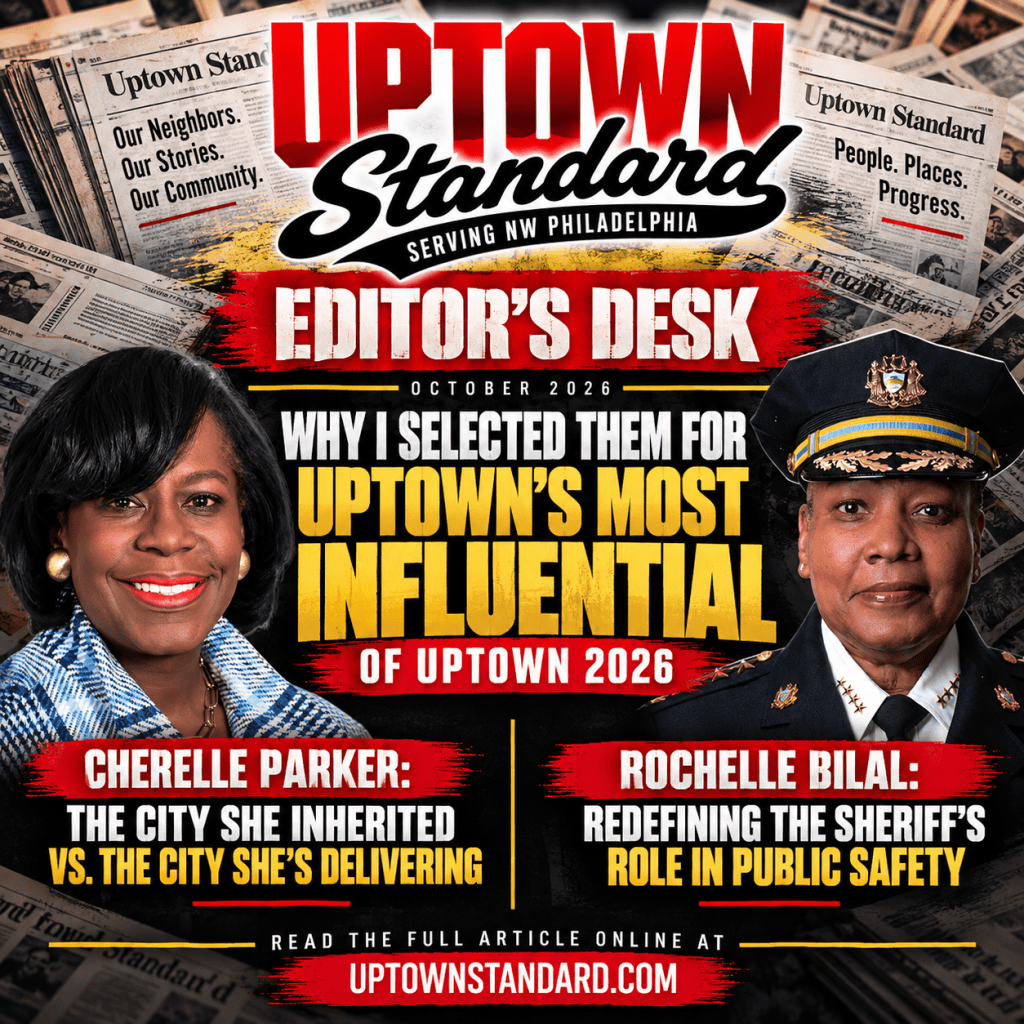
Why I Selected Mayor Cherelle Parker and Sheriff Rochelle Bilal for Uptown’s Most Influential 2026
UPTOWN STANDARD | EDITOR’S DESK
By JA Williams Jr | Publisher, Uptown Standard
October 2026
When Uptown Standard published its Uptown’s Most Influential 2026 list, two selections generated particularly strong reactions.
Philadelphia Mayor Cherelle Parker ranked No. 1. Philadelphia Sheriff Rochelle Bilal ranked No. 4.
Some readers questioned those selections. Others appeared genuinely offended that either woman would receive recognition.
I expected disagreement. What surprised me was how quickly the conversation shifted away from what these women have accomplished and toward everything critics dislike about them.
And let’s acknowledge something right from the beginning.
Both women are polarizing personalities who can cut a sound bite better than a WWE Superstar. Sometimes I wonder whether they’ve taken promotional lessons from Paul Heyman.
They know how to command attention, deliver a memorable line and dominate a political conversation.
But personality is not the same as performance.
Beyond the headlines, the sound bites and the controversies, what have they actually accomplished?
And why do we sometimes overlook the institutional problems they inherited?
That raises a question worth asking:
Where was this same outrage when men were running these institutions?
Both women inherited government institutions with problems that existed long before they took office. Both have faced legitimate criticism. And both have pursued initiatives that deserve examination alongside those criticisms.
My selections were not endorsements of everything they have done.
They were judgments about influence, leadership, institutional authority and the ability to shape Philadelphia’s future.
There is a difference.
I Know How City Hall Works
For some reason, people seem to assume that my opinions about Philadelphia’s elected officials should mirror those of the city’s mainstream newspapers.
But I don’t approach politics the same way.
I worked in Philadelphia City Council. I’ve written resolutions and attended more civic association meetings, police district town halls and zoning meetings throughout this city than I care to count.
I’ve seen firsthand how city government operates, how decisions are made, how legislation moves and how difficult it can be to turn a political promise into an actual government program.
I worked as a staffer for former City Councilmember David Oh and served as a Ward Leader in Philadelphia’s 50th Ward.
Those experiences gave me an understanding of Philadelphia politics from both inside government and at the neighborhood level.
I understand ward politics, civic organizations, neighborhood leadership, political relationships and the machinery behind decisions that affect our communities.
There is a difference between having a title, having authority and having political power. I understand all three.
I also understand something that often gets lost in public debate: the scope, scale, jurisdiction and actual authority of the office someone holds.
Not every elected official has the same powers. Not every government agency has the same resources. And not every problem people blame on an elected official falls within that official’s legal authority to solve.
That perspective informs my editorial decisions.
It doesn’t make my judgment beyond criticism. It means my judgment comes from a different set of experiences.
And I am comfortable with that.
Cherelle Parker: The City She Inherited vs. the City She’s Delivering
When Cherelle Parker became mayor in January 2024, she inherited a city struggling with gun violence, addiction, illegal dumping, deteriorating neighborhood conditions and concerns about the effectiveness of municipal services.
Philadelphia had experienced 562 homicides in 2021 under Mayor Jim Kenney.
There were 516 in 2022 and 410 in 2023, the year before Parker took office.
The downward trend had already begun. That matters.
But what happened during Parker’s administration matters, too.
Philadelphia recorded 269 homicides in 2024 and just 222 in 2025, the city’s lowest annual total since 1966.
By October 8, 2026, the Philadelphia Police Department reported 133 homicides, compared with 169 at the same point in 2025.
That represents another year-to-date decline of approximately 21 percent.
The improvement is measurable.
No mayor deserves exclusive credit for a reduction in crime. Police officers, prosecutors, community organizations, violence-prevention workers, changing criminal activity and national trends all influence those numbers.
But Philadelphia has historically held its mayors accountable for violent crime.
When homicides increase, residents blame City Hall.
When homicides decline, why should City Hall suddenly receive no credit?
Parker appointed Police Commissioner Kevin Bethel and made public safety a central priority of her administration.
Her administration has emphasized prevention, intervention and enforcement, alongside neighborhood-based public-safety strategies.
Those efforts deserve to be evaluated on their results.
The Frank Rizzo Comparison
Here is a historical comparison that may surprise some Philadelphians.
During Frank Rizzo’s mayoral administration, from 1972 through 1979, Philadelphia recorded more than 300 homicides every year.
In 2025, under Parker, the city recorded 222.
That is fewer homicides than in any individual year of Rizzo’s mayoral administration.
Of course, Philadelphia’s population, policing practices, demographics and social conditions have changed substantially since the 1970s.
The comparison does not prove that one mayor was personally responsible for more or fewer deaths.
But it challenges the idea that Philadelphia’s current leadership should be discussed without historical perspective.
If we are going to judge mayors by the condition of the city, we should apply that standard consistently.
Beyond Crime: Cleaning Up Philadelphia
Parker’s influence extends beyond public safety.
Her administration has emphasized neighborhood cleanliness through its Clean and Green initiatives, expanded sanitation efforts and corridor improvements.
These issues may not generate the same headlines as City Hall controversies, but they matter enormously to residents.
A vacant lot filled with trash affects property values, neighborhood morale and residents’ perception of whether their government cares about them.
An illegal dumping site that remains untouched for months sends a message.
So does a city administration that makes removing that trash a visible priority.
Parker has also advanced the H.O.M.E. housing initiative, intended to expand and preserve housing opportunities, and Extended Day, Extended Year programming to provide additional learning and enrichment time for students.
These are substantial policy commitments, even though their long-term outcomes will require continued scrutiny.
The question is not whether every initiative has succeeded.
The question is whether the administration is exercising its authority to address problems residents have complained about for years.
In my assessment, that effort deserves recognition.
Turning Chicken Into Chicken Salad
There’s an old saying about taking chicken shit and turning it into chicken salad.
That’s what effective political leadership is often asked to do.
A mayor doesn’t inherit a brand-new city.
A mayor inherits the finances, bureaucracy, public expectations, infrastructure and unresolved problems left by previous administrations.
Parker did not create Philadelphia’s opioid crisis.
She did not create its history of neighborhood neglect.
She did not create the city’s long-running struggles with violence.
But she inherited responsibility for addressing them.
And when an administration produces measurable improvements, I believe those improvements should be part of the conversation.
Rochelle Bilal: Redefining the Sheriff’s Role in Public Safety
My selection of Sheriff Rochelle Bilal generated a different kind of reaction.
Some critics appear to believe that any controversy surrounding the Sheriff’s Office should automatically disqualify its leader from being considered influential.
I disagree with that premise.
The Philadelphia Sheriff’s Office has experienced institutional problems across multiple administrations.
Those problems did not begin when Bilal was sworn in.
Former sheriffs John Green and Jewell Williams led the office before her, and the institution’s history includes longstanding concerns about administration, oversight and public confidence.
Recognizing that history does not excuse problems that continue today.
But it does establish an important distinction between inheriting an institution’s weaknesses and creating them.
Public Safety Beyond the Traditional Sheriff’s Role
The public often associates the Sheriff’s Office primarily with court security, prisoner transportation and civil enforcement.
Those responsibilities remain central to the office.
But Bilal has also placed greater public emphasis on law-enforcement partnerships, fugitive apprehension and firearm recovery.
Her office has reported a 75 percent increase in fugitive apprehensions over a two-year period.
It has also reported more than 300 firearms recovered through domestic-violence enforcement and multiagency task-force operations.
These are agency-reported results, and joint operations should not be credited exclusively to the Sheriff’s Office.
Nevertheless, the work illustrates how the office participates in broader public-safety efforts.
There is an important difference between the legal jurisdiction of a sheriff and the political influence that sheriff can exercise through partnerships, resource allocation and public engagement.
Bilal’s approach has brought greater visibility to those public-safety functions.
That visibility was part of my assessment.
The Autism Work Is Personal to Me
One of Bilal’s initiatives deserves particular attention.
I previously worked for Autism Cares, an organization serving individuals with autism and their families.
That experience gave me an appreciation for the challenges families can face during encounters with emergency responders and law enforcement.
A person with autism may communicate differently, struggle with unfamiliar instructions or react unpredictably to a stressful situation.
An officer who misunderstands that behavior can unintentionally escalate an encounter.
Bilal’s Sheriff’s Office launched an Autism Decal Program in 2023 to help alert emergency responders when an autistic individual may be present in a home or vehicle.
The office also expanded specialized autism training and received Certified Autism Center recognition in 2025.
According to the certification announcement, 320 sworn and civilian employees completed training associated with that designation.
The Sheriff’s Office has also hosted autism and neurodiversity community events connecting families with information and resources.
These initiatives are not a substitute for broader accountability or professional law-enforcement standards.
They are, however, tangible examples of an agency attempting to improve its interactions with a population that can face particular challenges during emergencies.
Having worked for Autism Cares, I value Bilal’s efforts to improve autism awareness and safety in law enforcement.
That work deserves recognition regardless of whether someone likes Bilal personally.
They Both Have Negatives. We Already Know That.
I am not suggesting that Cherelle Parker or Rochelle Bilal should be immune from criticism.
Both have shortcomings.
We know them.
Government officials should be questioned about their decisions, spending, management practices and results.
That is part of public accountability.
But I reject the idea that criticism should erase every accomplishment.
In my assessment, the positive contributions of Parker and Bilal outweigh their negatives, particularly when viewed against the institutional problems they inherited.
That is an editorial judgment, not a claim that every policy or decision has been successful.
Readers are free to reach different conclusions.
But the discussion should include the full record rather than only the controversies that generate the strongest reactions.
Where Was This Outrage Before?
This is the question that continues to interest me.
Where was this same level of outrage when men were running these institutions?
Philadelphia’s problems with violent crime, neglected neighborhoods, government bureaucracy and institutional oversight did not suddenly appear when these two Black women took office.
Those problems existed under previous administrations, many led by men.
That does not mean previous leaders escaped criticism. They certainly did not.
Nor does it mean that every criticism of Parker or Bilal is motivated by race or gender.
But it is reasonable to examine whether public expectations and the intensity of criticism are applied consistently.
When a woman inherits a troubled institution, is she judged only by the problems that remain?
Or do we also acknowledge the improvements made under her leadership?
When a male predecessor leaves behind longstanding institutional problems, how much of that history remains part of the conversation?
Those questions matter.
And they are worth asking without turning every disagreement into an accusation.
Influence Is Not the Same as Popularity
Perhaps the biggest misunderstanding surrounding Uptown Standard’s list is the assumption that being influential means being universally admired.
It doesn’t.
Influence is not a popularity contest.
It is not an approval rating.
It is not a declaration that someone has made every correct decision.
Influence is about the ability to shape decisions, affect institutions, direct resources, command attention and change the direction of a community.
The mayor of Philadelphia has extraordinary influence over municipal priorities, public spending, department leadership and the city’s policy agenda.
The sheriff exercises a different and more limited set of statutory powers, but can still influence public safety, institutional practices and community relationships.
Those differences in authority matter.
They were part of my editorial consideration.
Recognition is not an endorsement.
And criticism does not automatically eliminate influence.
I Stand Behind My Editorial Judgment
I could have made safer selections.
I could have chosen people whose names would generate less controversy.
I could have avoided explaining why I considered Parker and Bilal influential.
But that would defeat the purpose of publishing an independent editorial list.
Uptown Standard exists to document the people, decisions and institutions shaping our communities.
That includes people readers admire.
It also includes people readers question.
My responsibility as publisher is not to produce a list that everyone agrees with.
It is to make editorial judgments that I can explain and defend.
Mayor Cherelle Parker and Sheriff Rochelle Bilal have both inherited institutions with substantial challenges.
Their records deserve scrutiny, including legitimate criticism.
But their public-safety efforts, institutional initiatives and influence on Philadelphia’s civic conversation also deserve consideration.
That is why I selected them for Uptown’s Most Influential 2026.
And I stand behind those selections.
UPTOWN STANDARD
Our Neighbors. Our Stories. Our Community.
UPTOWNSTANDARD.COM

