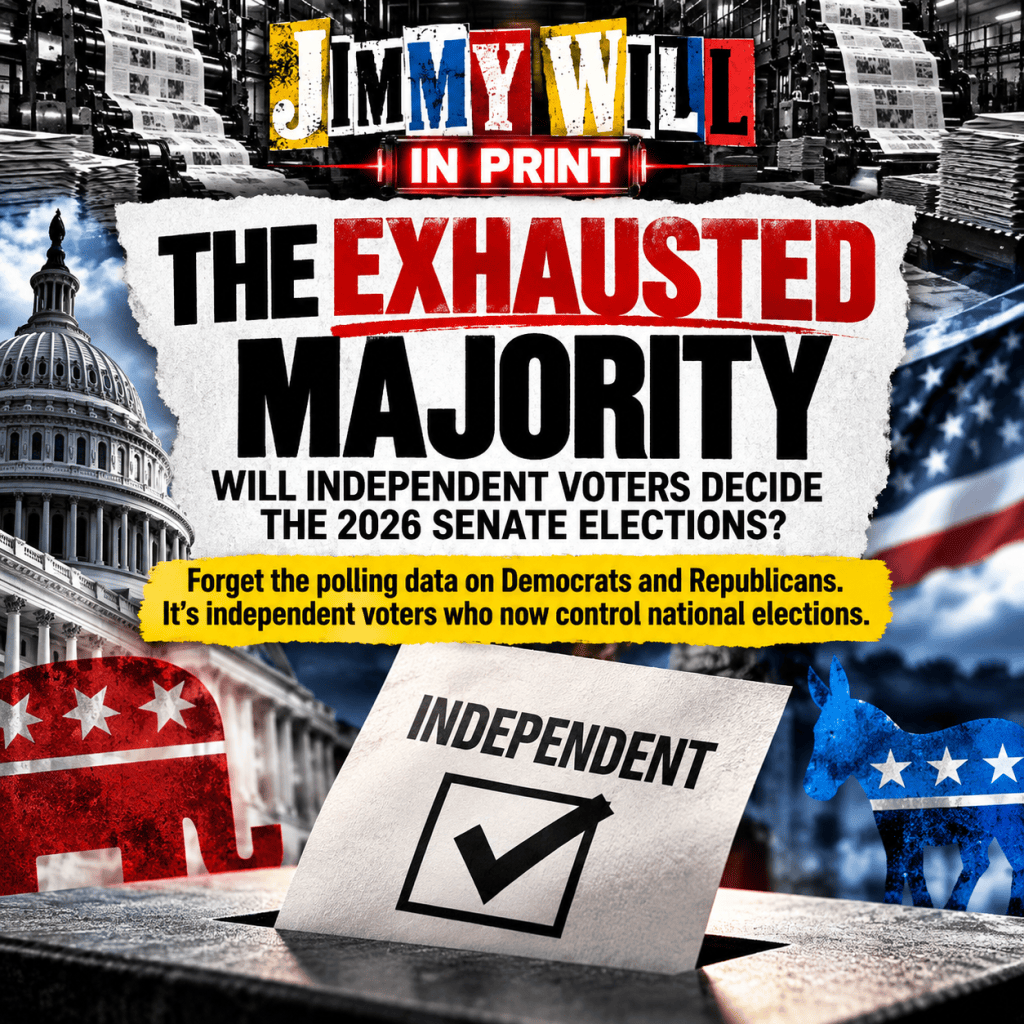
Forget the polling data on Democrats and Republicans. It’s independent voters who now control national elections.
By JA Williams Jr.
As the 2026 midterm elections approach, political analysts continue to focus on President Donald Trump’s approval ratings and whether the election will serve as a national referendum on his presidency.
But I believe there’s another political story worth examining.
What happens when independent voters begin evaluating candidates on their own merits rather than simply voting for or against the president?
And could the candidates running for governor have a greater influence on Senate elections than the president himself?
The House and Senate Are Two Different Political Battles
National polling has shown Democrats holding an advantage on the generic congressional ballot, suggesting a favorable political environment for Democratic House candidates.
But the Senate is a different political contest.
Senators represent entire states, and their political identities can extend beyond national party leadership.
A Republican Senate candidate may appeal to voters who disapprove of Trump. A Democratic Senate candidate may attract voters who otherwise support Republican candidates.
That distinction becomes especially important in states where voters are simultaneously choosing a governor and a United States senator.
The question isn’t simply which political party is more popular nationally. It’s whether individual candidates can build enough support within their states to win.
The Independent Voter Factor
As a registered independent, this is the first election cycle in which I’ve been absolutely bombarded with political text messages from both sides of the aisle.
Republicans want my vote. Democrats want my vote. And both parties seem determined to convince me that the other side is the problem.
But receiving more political messages doesn’t necessarily make a voter more committed to either party.
It raises a different question: Are these campaigns actually persuading independent voters, or are they simply contributing to political exhaustion?
Independent voters aren’t one unified political group. Some lean Republican, others lean Democratic, and some approach each election without a consistent party preference.
And there’s another important distinction. Not every registered independent is a swing voter. Some independents consistently vote for one party even though they decline to identify formally with it.
The voters I’m most interested in are those willing to consider candidates from either party based on their records, qualifications, political independence, and ability to deliver results.
I believe the real story of the 2026 midterms isn’t simply how Democrats and Republicans are polling nationally. It’s how independent voters are evaluating the candidates running in their respective states.
And perhaps that’s where the real political leverage exists.
Could Governors Have More Influence Than Trump?
One of the overlooked dynamics of the 2026 elections is the potential relationship between gubernatorial candidates and Senate candidates appearing on the same ballot.
A competitive gubernatorial campaign can energize voters, increase turnout, and potentially benefit other candidates from the same party.
But the reverse is also possible.
Voters may support one party for governor and another for the Senate.
Consider several states.
Florida: Republican Byron Donalds and Democrat David Jolly are competing for governor, while Republican Ashley Moody and Democrat Angie Nixon are competing for Senate. The two contests offer an opportunity to examine whether independents make different decisions about each office.
Michigan: Democrat Jocelyn Benson’s gubernatorial campaign and Democrat Abdul El-Sayed’s Senate campaign provide an opportunity to examine whether support for one statewide candidate translates into support for another.
Ohio: Republican Vivek Ramaswamy and Democrat Amy Acton are competing for governor, while Republican Jon Husted and Democrat Sherrod Brown are running for Senate. Their campaigns provide another test of whether candidate appeal or national political loyalties shape voter behavior.
Georgia: Republican Rick Jackson and Democrat Keisha Lance Bottoms are competing for governor, while Democratic Senator Jon Ossoff faces Republican Mike Collins. Georgia offers another opportunity to examine split-ticket voting and the influence of independent voters.
New Hampshire: Republican Governor Kelly Ayotte and Democratic Senate candidate Chris Pappas have demonstrated different patterns of support in their respective races. Recent polling has shown the possibility of voters supporting a Republican governor while preferring a Democrat for Senate.
These contests offer an opportunity to examine whether gubernatorial candidates create coattails or whether independent voters are comfortable splitting their tickets.
Texas: The Independent Voter Test
Texas may provide one of the most interesting examples of the independent voter’s influence in 2026.
Recent polling shows Republican Governor Greg Abbott maintaining support in his reelection campaign while Democrat James Talarico is running competitively against Republican Ken Paxton for the United States Senate.
An October 29 CNN poll showed Abbott leading Democrat Gina Hinojosa 48% to 46%, while Talarico led Paxton 49% to 43%.
Think about that.
The same electorate is being asked to choose a governor and a senator, yet the polling shows different preferences for the two offices.
That doesn’t necessarily mean voters are abandoning their political beliefs. It may mean they are evaluating candidates differently.
And with millions of Texans already participating in early voting, the question becomes whether independent voters will reinforce traditional party loyalties or produce a meaningful amount of ticket splitting.
Texas does not register voters by political party, so estimates of independent participation are based on voting history and other modeling rather than official independent registration.
That distinction matters when interpreting turnout figures.
Congress Has Its Own Approval Problem
There’s another reason I question the emphasis on presidential approval ratings alone.
Congress has an approval problem of its own.
Americans can disapprove of Congress more strongly than they disapprove of the president.
Yet congressional approval doesn’t tell us how voters feel about an individual senator or candidate.
A voter can be frustrated with Washington while respecting their own senator’s record.
Likewise, a voter can disapprove of Trump while supporting a Republican Senate candidate, just as someone who supports Trump may choose a Democrat for another office.
The critical distinction is between how voters feel about political institutions and how they evaluate individual candidates.
Presidential approval can still influence congressional elections. But it doesn’t necessarily explain every vote, especially in states with competitive gubernatorial and Senate races.
And that’s why I believe presidential approval ratings don’t tell the entire story of the Senate elections.
Are Independents Really the Exhausted Majority?
Perhaps the most overlooked group in this election is what I call the exhausted majority.
These are Americans who are tired of partisan fighting, political advertisements, constant text messages, and being told that every election is a battle between good and evil.
They aren’t necessarily disengaged from politics.
Some may be paying closer attention than ever, evaluating candidates individually rather than accepting party messaging.
But there’s an important distinction between being independent and being politically exhausted.
Not every independent voter is undecided, and not every politically frustrated voter is independent.
The exhausted majority is a way of describing a political attitude, not a formally measured voting bloc.
Still, I believe there’s a significant political conversation being overlooked.
What happens when voters become so exhausted by partisan messaging that they begin looking more closely at the individuals running for office?
That doesn’t guarantee they will abandon their usual party preferences. It does raise questions about how campaigns communicate with voters who don’t want every election reduced to a referendum on the president.
Both parties are competing for their support, but neither can assume that dissatisfaction with the other party automatically translates into a vote for its own candidates.
Independent Turnout Could Be Just as Important as Independent Preferences
Another factor worth watching is turnout.
Polling can tell us which candidates independent voters say they prefer. But elections are decided by the people who actually cast ballots.
A competitive governor’s race may motivate voters who otherwise would have stayed home. Those voters then have an opportunity to participate in the Senate election.
That is one way gubernatorial campaigns can influence Senate contests without necessarily changing anyone’s political opinions.
There’s also the possibility of split-ticket voting.
A voter may support a Republican governor and a Democratic senator, or vice versa, because they see different qualifications, responsibilities, or policy priorities associated with each office.
These are two separate electoral dynamics.
One concerns who participates.
The other concerns how those voters make their choices.
Both deserve attention when examining the influence of independents.
The Real Test Comes in November
The question isn’t simply whether Democrats or Republicans are leading in national polling.
It’s whether individual candidates can earn the confidence of independent voters in their respective states.
Will independents support the same party for governor and Senate?
Will they split their tickets?
Will a popular gubernatorial candidate influence the Senate contest more than the president?
Or will national party loyalty remain the deciding factor?
Perhaps the most revealing results on Election Night won’t simply be which party wins each state.
They’ll be the states where voters choose a Republican governor and a Democratic senator, or vice versa.
Those results could tell us something important about the continued relevance of individual candidates in American politics.
Final Thought
As a registered independent, I don’t believe every election should be viewed exclusively through the lens of the president.
Candidates have their own records, qualifications, political philosophies, and responsibilities to the people they seek to represent.
And voters have the opportunity to evaluate them accordingly.
Both Democrats and Republicans are competing for independent support. But political outreach alone doesn’t guarantee political loyalty.
Let’s see which party—and more importantly, which candidates—can earn the confidence of the exhausted majority in their respective states.
Because getting an independent voter’s attention is one thing.
Earning that voter’s vote is something entirely different.
I’m Jimmy Will, and that’s my perspective in print.
PHLStandard.com
Disclosure: This article was written by JA Williams Jr., doing business as Jimmy Will, with research assistance and editorial support from ChatGPT. The accompanying cover image was also created using ChatGPT.

