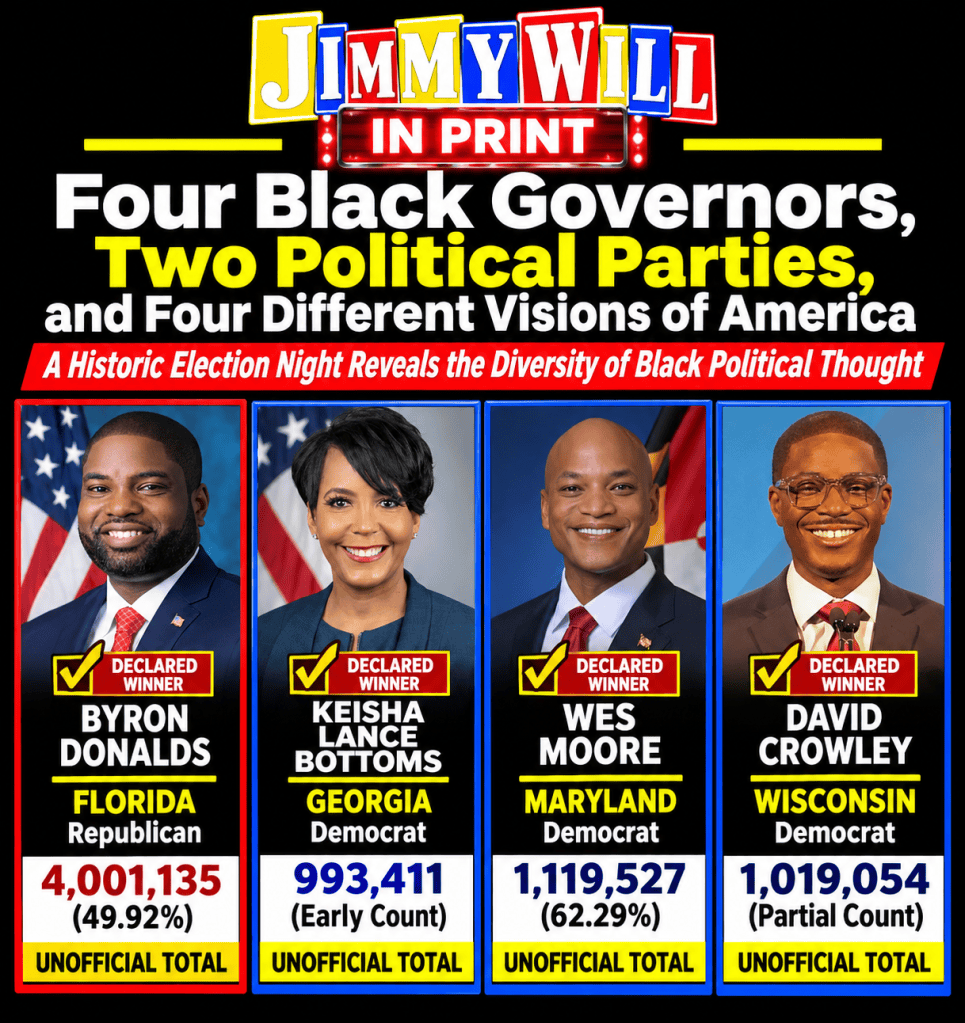
A Historic Election Night Reveals the Diversity of Black Political Thought
By JA Williams Jr.
American political history was made on November 3, 2026, when four Black Americans won gubernatorial elections on the same night, setting the stage for four elected Black governors to serve simultaneously for the first time in United States history.
Republican Byron Donalds won in Florida. Democrats Keisha Lance Bottoms and David Crowley won in Georgia and Wisconsin, respectively, while Maryland Governor Wes Moore secured reelection.
Before this election, only three Black Americans had ever been elected governor: Douglas Wilder of Virginia, Deval Patrick of Massachusetts, and Wes Moore of Maryland.
Now four have won on the same night.
That alone is remarkable. But what interests me most is not simply their race. It is their different political philosophies, personal backgrounds, approaches to government, and potential roles in the future of American politics.
Three are Democrats. One is a Republican. All four have different ideas about how government should serve its citizens.
And that is what makes this moment so significant.
A HISTORIC ELECTION NIGHT
The four victories represent important milestones in American politics.
Byron Donalds, Republican, Florida: 4,001,135 votes.
Keisha Lance Bottoms, Democrat, Georgia: 993,411 votes.
Wes Moore, Democrat, Maryland: 1,119,527 votes.
David Crowley, Democrat, Wisconsin: 1,019,054 votes.
These are unofficial election-night snapshots, not certified final totals. The Georgia and Wisconsin figures reflect incomplete reporting and should not be interpreted as final statewide totals.
The election of Donalds makes him Florida’s first Black governor and the first Black Republican elected governor in American history.
Bottoms becomes Georgia’s first Black governor and the first Black woman elected governor anywhere in the United States.
Crowley becomes Wisconsin’s first Black governor.
Moore, already Maryland’s first Black governor, adds a second statewide victory to his political résumé.
Beyond these historic firsts, each governor offers a different perspective on economic opportunity, government responsibility, education, public safety, and the future of American leadership.
BYRON DONALDS: BLACK CONSERVATISM IN THE POLITICAL MAINSTREAM
Florida’s Byron Donalds represents the conservative side of this historic group.
A Republican closely aligned with President Donald Trump, Donalds believes economic opportunity is best advanced through lower taxes, private enterprise, school choice, and reduced government intervention.
His campaign emphasized property tax relief, homeowners insurance affordability, educational choice, and continuing much of the conservative agenda established under Governor Ron DeSantis.
Donalds represents a political philosophy that places significant responsibility on individuals, families, businesses, and communities rather than relying primarily on government programs.
His approach differs considerably from that of the three Democratic governors.
Where Democrats often emphasize government investment as a tool for expanding opportunity, Donalds argues that reducing government burdens can allow individuals and businesses to prosper.
His election is especially significant because he won statewide office as a Black Republican without making racial identity the central argument of his campaign.
Stephen A. Smith and the Breakfast Club Confrontation
One of the more interesting public assessments of Donalds came from ESPN personality and political commentator Stephen A. Smith, who described Donalds as “the real deal.”
Smith’s favorable assessment of Donalds’ political communication illustrates how a Republican politician can attract attention from commentators who do not necessarily share his party affiliation.
Donalds also appeared on The Breakfast Club on Election Day, where he engaged in a heated political exchange with commentator Angela Rye.
Their disagreement involved voting rights, affirmative action, diversity initiatives, and support for historically Black colleges and universities.
Rye challenged Donalds on Republican policies and their consequences for Black Americans. Donalds defended his positions and challenged her interpretation of his record.
In my opinion, Donalds owned that exchange.
He stood his ground and challenged Rye’s arguments. I appreciated seeing a Black Republican defend his political positions in an environment where those positions were being vigorously questioned.
Others may have viewed the exchange differently, particularly those who agreed with Rye’s concerns about civil rights protections.
But for me, the larger issue is whether Black political viewpoints can be debated on their merits rather than dismissed because they do not align with traditional Black Democratic politics.
Donalds’ election provides an opportunity to examine whether conservative economic policies can produce measurable improvements in affordability, education, and economic mobility.
That is how his administration should ultimately be evaluated.
KEISHA LANCE BOTTOMS: IT’S ABOUT TIME
Georgia’s Keisha Lance Bottoms represents a substantially different political philosophy.
The former Atlanta mayor believes government has an important responsibility to address economic inequality, expand access to health care, strengthen public education, and protect civil rights.
Her campaign emphasized expanding Medicaid, increasing the minimum wage, supporting teachers and public safety employees, and protecting reproductive rights.
Where Donalds emphasizes limiting government’s role in economic life, Bottoms sees public investment and government protections as important tools for improving economic opportunity.
But what interests me most about Bottoms is her political résumé.
She has served as a prosecutor, magistrate judge, Atlanta City Council member, mayor of one of America’s most influential cities, and senior adviser in the Biden White House.
Her background includes criminal justice, law enforcement, municipal administration, and national politics.
In my opinion, Bottoms has not received nearly enough attention for her political experience and qualifications.
It’s about time.
I believed Joe Biden should have selected Bottoms over Kamala Harris as his vice-presidential running mate in 2020.
That is not a dismissal of Harris’ qualifications. Harris brought experience as California’s attorney general and a United States senator.
But Bottoms brought something different: direct executive experience managing a major American city, overseeing budgets, dealing with public safety challenges, and working with law enforcement.
Her tenure as Atlanta mayor was not without controversy, particularly regarding crime and the challenges of governing during the pandemic. Those issues deserve consideration alongside her accomplishments.
Now, with her historic victory in Georgia, Bottoms adds statewide executive leadership to an already extensive résumé.
I hope this gives her greater leverage in national Democratic politics.
I would welcome seeing her considered for a senior position in a future presidential administration, the vice presidency, or even a future presidential campaign.
Much of the conversation about the Democratic Party’s future has focused on figures such as California Governor Gavin Newsom.
I would like to see Bottoms receive more attention in those same conversations.
She brings Southern political experience, legal credentials, executive leadership, and White House service.
Her election gives her an opportunity to demonstrate how those experiences translate into governing an entire state.
For me, Bottoms is more than a historic first. She is a political figure whose experience deserves serious national consideration.
WES MOORE: A GOVERNOR WHO KNOWS HIS HIP-HOP
Maryland’s Wes Moore represents another approach to Democratic leadership.
A military veteran, businessman, author, and former nonprofit executive, Moore combines support for government investment with an emphasis on entrepreneurship, employment, individual responsibility, and economic development.
His philosophy suggests that public investment and private achievement do not have to be competing ideas.
Government can help create opportunities, while individuals, families, and businesses take responsibility for building economic success.
Moore has emphasized workforce development, public education, business growth, public safety, and infrastructure investment.
His approach offers an interesting contrast with Donalds.
Both discuss economic opportunity and personal achievement. However, Moore generally supports a more active government role in creating the conditions for that opportunity.
A Governor Who Can Give You a Freeway Verse
One thing I particularly like about Wes Moore is his connection to hip-hop culture.
I like a governor who can give you an entire verse from Philadelphia rapper Freeway’s classic “What We Do.”
There is something refreshing about a political leader who can move between discussions of economic policy, military service, and public administration while remaining connected to the music and culture that shaped his generation.
For me, that cultural familiarity is part of Moore’s appeal.
It doesn’t make him a better governor, and it certainly doesn’t replace a strong governing record.
But it demonstrates a side of political leadership that traditional résumés cannot capture.
Moore represents a generation of Black leadership that doesn’t have to separate professional accomplishment from cultural identity.
And sometimes, knowing a Freeway verse tells you something about the generation a politician comes from that no campaign biography ever could.
Wes Moore and the Presidency
In my opinion, Wes Moore belongs on every serious Democratic vice-presidential consideration list.
Moore brings an unusual combination of military service, business experience, community leadership, and executive experience to American politics.
I believe Moore is the real deal.
However, there is a difference between having presidential potential and developing the national experience, relationships, and visibility necessary to pursue the presidency.
I believe another decade in the national spotlight could benefit Moore, allowing Americans beyond Maryland to become more familiar with his leadership and governing philosophy.
I see him as a potential future president of the United States.
Of course, his political future will depend on his governing record, the national political environment, and how voters respond to his leadership.
But his rise demonstrates the expanding possibilities for Black political leadership beyond traditional congressional and municipal offices.
DAVID CROWLEY: YOUNG, EXPERIENCED, AND WORTH WATCHING
Wisconsin’s David Crowley may be the least nationally recognized of these four governors, but his political journey deserves attention.
At just 40 years old, Crowley has already served in the Wisconsin State Assembly, become Milwaukee County’s first Black county executive, and won election as Wisconsin’s first Black governor.
His story is particularly compelling because he grew up in poverty in Milwaukee, experienced housing insecurity, and worked his way through community organizing and local government into statewide leadership.
Politically, Crowley represents a working-class Democratic philosophy emphasizing affordable housing, public education, health care, organized labor, and government services.
He has also demonstrated a willingness to work across party lines.
As Milwaukee County Executive, he helped negotiate a fiscal agreement with Republican legislators that provided additional revenue to stabilize local government finances.
That agreement also illustrates the difference between Crowley’s approach and the tax-reduction philosophy of Donalds.
Crowley has demonstrated a willingness to support additional revenue when he believes it is necessary to maintain public services.
What impresses me most about Crowley is his age.
At 40, winning a governorship is a significant accomplishment.
He has the opportunity to spend many more years developing his political identity, building a governing record, and establishing himself in the national spotlight.
Unlike politicians who reach statewide office late in their careers, Crowley has time on his side.
I admittedly have not followed his career as closely as those of Byron Donalds, Wes Moore, or Keisha Lance Bottoms.
But his background, accomplishments, and relatively young age make him someone worth watching.
His political future will depend on what he accomplishes in Wisconsin, particularly his ability to deliver economic improvements for working families and govern effectively across political divisions.
For now, his election represents more than another historic first. It introduces a new generation of Black executive leadership with the possibility of a long career in American politics.
FOUR GOVERNORS, FOUR DIFFERENT APPROACHES TO GOVERNMENT
Despite their political differences, these four governors share many of the same broad concerns.
Families want affordable housing, good schools, safe neighborhoods, quality health care, and opportunities to build wealth.
The disagreement is largely about how government should help accomplish those goals.
Donalds emphasizes lower taxes, private enterprise, limited government, and individual choice.
Bottoms emphasizes public investment, expanded health care, economic protections, and civil rights.
Moore seeks to combine economic development, entrepreneurship, individual responsibility, and strategic government investment.
Crowley emphasizes working-class economics, public services, organized labor, and practical government administration.
These are legitimate differences in political philosophy.
And those differences should be examined through public policy, economic outcomes, and governing records rather than racial expectations.
BLACK POLITICAL LEADERSHIP IS NOT A MONOLITH
Perhaps the most important lesson of the 2026 gubernatorial elections is that Black political identity does not automatically produce a single set of political beliefs.
Black Americans can share similar family histories, religious traditions, economic challenges, and cultural experiences while reaching different conclusions about public policy.
Some believe government must play a larger role in addressing economic and social inequalities.
Others believe reducing government intervention creates greater opportunities for individual achievement and economic independence.
Still others believe the strongest approach combines public investment, private enterprise, and community responsibility.
Those differences deserve serious political debate.
The election of Byron Donalds alongside Keisha Lance Bottoms, Wes Moore, and David Crowley illustrates that Black Americans can compete successfully for statewide executive leadership while advancing different political philosophies.
The significance of this election is not that Black Americans have finally reached political agreement.
It is that their political diversity is now represented in the governor’s offices of four states.
BEYOND REPRESENTATION: THE REAL TEST IS RESULTS
Representation matters.
The historical barriers these elections overcome should not be minimized.
But representation alone does not guarantee better schools, safer neighborhoods, affordable housing, stronger businesses, or greater economic security.
The true measure of these four governors will be their ability to govern effectively.
Will Donalds’ conservative economic policies make Florida more affordable?
Will Bottoms’ public investment priorities improve economic mobility and access to health care in Georgia?
Will Moore’s combination of public investment and economic development strengthen Maryland’s middle class?
Will Crowley’s approach to government improve public services while maintaining fiscal stability in Wisconsin?
Those are the questions voters should ask, regardless of a governor’s race or political affiliation.
The historic achievement of November 3, 2026, is that four Black Americans have won elections to lead four states simultaneously.
The larger opportunity is to demonstrate that Black political leadership is broad enough to encompass competing ideas, independent thinking, different cultural experiences, and different approaches to governing.
Black political progress should not be measured only by how many Black candidates win office, but also by the freedom of Black Americans to disagree politically, compete openly, and be judged by the results of their leadership.
That may ultimately be the most important legacy of this historic election night.

