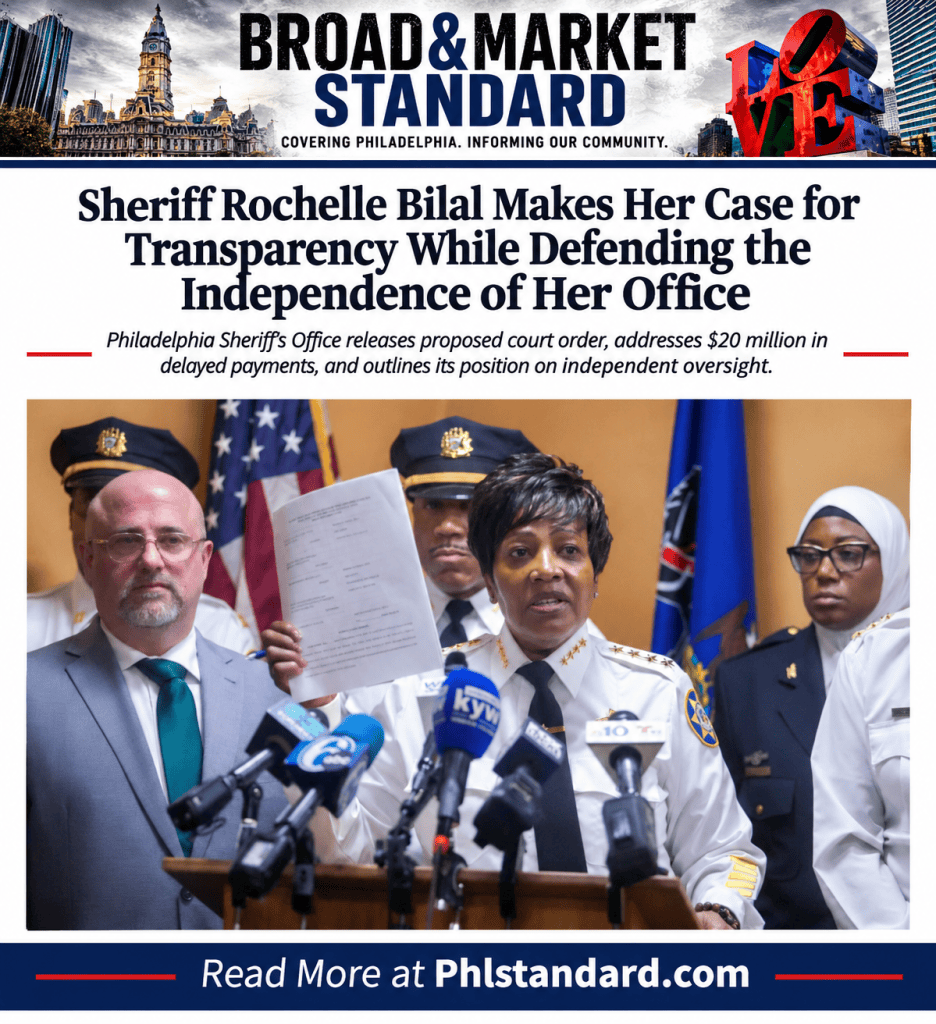
Philadelphia Sheriff’s Office releases proposed court order, addresses $20 million in delayed payments, and outlines its position on independent oversight.
By Broad & Market Standard | November 5, 2026
Philadelphia Sheriff Rochelle Bilal is making it clear that her office is not opposed to transparency, independent audits, or accountability. What she is challenging are the terms under which outside oversight would be imposed on an independently elected office.
During a press conference featuring Sheriff Bilal and Senior Deputy Undersheriff Steven A. Wakefield, the Philadelphia Sheriff’s Office released its proposed version of a court order that had been the subject of settlement negotiations.
The decision to make the document public offers residents an opportunity to examine the Sheriff’s position rather than relying solely on competing interpretations of the legal dispute.
At the center of the controversy are longstanding administrative problems involving sheriff’s sales, the distribution of proceeds, the issuance of property deeds, and the appropriate scope of court-appointed oversight.
But the documents also reveal something important: many of these problems existed long before Sheriff Bilal took office.
A Problem That Predates the Current Sheriff
One of the most significant details in the proposed court order is its acknowledgment that previous administrations struggled with the timely issuance of deeds and distribution of sheriff’s sale proceeds.
The document references a 2003 court order involving former Sheriff John Green, as well as previous audits and investigations examining accounting deficiencies within the office.
This historical context matters.
Sheriff Bilal inherited an office with documented administrative problems, some of which had required judicial intervention years before her administration began.
That history does not eliminate the current administration’s responsibility to correct deficiencies. However, it does demonstrate that Philadelphia’s sheriff’s sale problems cannot reasonably be attributed exclusively to the current sheriff.
Any serious examination of the office should recognize the institutional challenges that have persisted across administrations.
The $20 Million in Delayed Payments
The Sheriff’s Office also addressed approximately $20 million in sheriff’s sale proceeds that had been processed and queued for disbursement but had not completed the final payment process.
According to the Office, the issue was discovered through an internal review initiated under new Real Estate Department leadership.
Once identified, the Office says corrective action began, outstanding payments were processed, and affected accounts were placed under reconciliation.
The Office also reports implementing improved tracking procedures and system alerts designed to prevent similar delays.
Most importantly, the Sheriff’s Office maintains that no funds were missing.
There is an important distinction between money that cannot be accounted for and money that has not been distributed because of administrative failures.
While delayed payments are a legitimate concern, they should not automatically be characterized as missing or stolen funds without supporting evidence.
The fact that the Office says it identified the problem internally and initiated corrective measures deserves consideration.
Nevertheless, the public should receive a complete accounting of how the delays occurred, how long they lasted, and whether all affected parties have received their payments.
Independent Oversight Does Not Have to Mean Surrendering Authority
Perhaps the strongest argument presented by Sheriff Bilal concerns the authority of her office.
The sheriff is independently elected by Philadelphia voters. That distinction carries both constitutional and statutory responsibilities.
The proposed order released by the Sheriff’s Office would establish a Special Compliance Examiner, an advisory committee, and an independent forensic auditor.
However, the Sheriff’s proposed revisions seek to clarify that outside examiners would not assume operational control, direct employees, or exercise the statutory powers of the sheriff.
That is a reasonable issue to raise during negotiations.
An independent audit is intended to examine records, identify deficiencies, and recommend corrective action. It does not necessarily require transferring management authority from an elected official to an outside entity.
The Sheriff’s proposed language also establishes procedures for access to records, protection of confidential information, and resolution of disputes before the court.
Those provisions reflect an effort to define the boundaries of oversight, although their practical effect on the scope of an investigation remains an important consideration.
Why Negotiations Failed
According to the Sheriff’s Office, its legal representatives proposed revisions during settlement discussions, including provisions addressing financial obligations that had not been funded by City Council.
The Office maintains that it cannot commit public funds that have not been appropriated.
That is a legitimate governmental concern.
Court-supervised reforms can require significant financial resources, particularly when independent examiners, forensic auditors, and additional administrative systems are involved.
The Sheriff’s Office says JSB Property Group LLC rejected its proposed changes, preventing the parties from reaching a negotiated settlement.
That is the Sheriff’s account of the negotiations. The plaintiff’s reasoning and the court’s assessment would be necessary to establish a complete account of why settlement efforts failed.
Importantly, the proposed order itself states that the contemplated agreement would not constitute an admission of wrongdoing or a final determination of disputed claims.
The City Controller Offers Another Avenue for Accountability
Sheriff Bilal has also pointed to the Philadelphia City Controller’s Office as an existing independent auditing authority.
Rather than creating an entirely separate oversight structure, the Sheriff says her office welcomes cooperation with the Controller in conducting an audit.
This position raises a practical question about the most effective use of taxpayer resources.
If an independent public auditing office already possesses the authority and expertise to examine financial operations, it is reasonable to consider what additional responsibilities would require a separate court-appointed forensic auditor.
At the same time, a Controller’s audit and a court-supervised forensic examination may serve different purposes and have different scopes.
The question should not simply be whether oversight occurs, but whether the oversight structure is effective, appropriately funded, legally sound, and capable of producing meaningful results.
The Court Has a Responsibility, Too
The Philadelphia Court of Common Pleas has an important role in ensuring compliance with legal obligations and addressing disputes involving sheriff’s sales.
Its involvement is not new.
The proposed order references prior court intervention, including litigation dating back more than two decades.
The court must consider the interests of property owners, purchasers, creditors, and other parties affected by delays or irregularities in sheriff’s sale transactions.
At the same time, the legal process must account for the statutory responsibilities of the Sheriff’s Office and the practical limitations of administering a public agency.
These are not necessarily competing goals.
Judicial oversight and independent elected authority can coexist when responsibilities are clearly defined and the remedies imposed are consistent with the law.
Transparency Should Be Measured by Results
Sheriff Bilal’s decision to release the proposed order is a constructive step toward public transparency.
Rather than simply issuing a statement opposing the court process, the Sheriff’s Office has provided documentation showing the revisions it sought and the conditions under which it says it was prepared to cooperate.
That allows the public to evaluate the substance of its position.
But transparency ultimately requires more than releasing documents or holding press conferences.
It requires accurate accounting, timely distribution of funds, reliable recordkeeping, and measurable improvements in government services.
The Sheriff’s Office should be evaluated on those results, including whether the corrective measures it describes actually resolve the problems identified.
The Bigger Picture
Philadelphia residents have a legitimate interest in knowing that the Sheriff’s Office is operating efficiently and that money collected through sheriff’s sales reaches its rightful recipients.
They also have an interest in ensuring that an independently elected office retains the authority necessary to fulfill its responsibilities.
Sheriff Rochelle Bilal has presented a case that these two principles do not have to be in conflict.
Her administration acknowledges operational deficiencies, says it has initiated corrective action, and maintains that it is willing to cooperate with independent oversight.
Those positions deserve to be examined on their merits rather than automatically interpreted as resistance to accountability.
The courts must continue to address the legal issues before them, and the Sheriff’s Office must demonstrate that its reforms are producing results.
Ultimately, Philadelphia does not need a political battle between the judiciary and the Sheriff’s Office. It needs a functioning sheriff’s sale system, accountable management, and public confidence that the law is being followed.
If Sheriff Bilal can deliver those outcomes while preserving the independence of her elected office, that would represent meaningful progress for Philadelphia taxpayers and the people who depend on the services her office provides.
—
Broad & Market Standard — The Ward
Covering Philadelphia politics, government, and the people shaping the city’s future.
Read more at PHLStandard.com.

