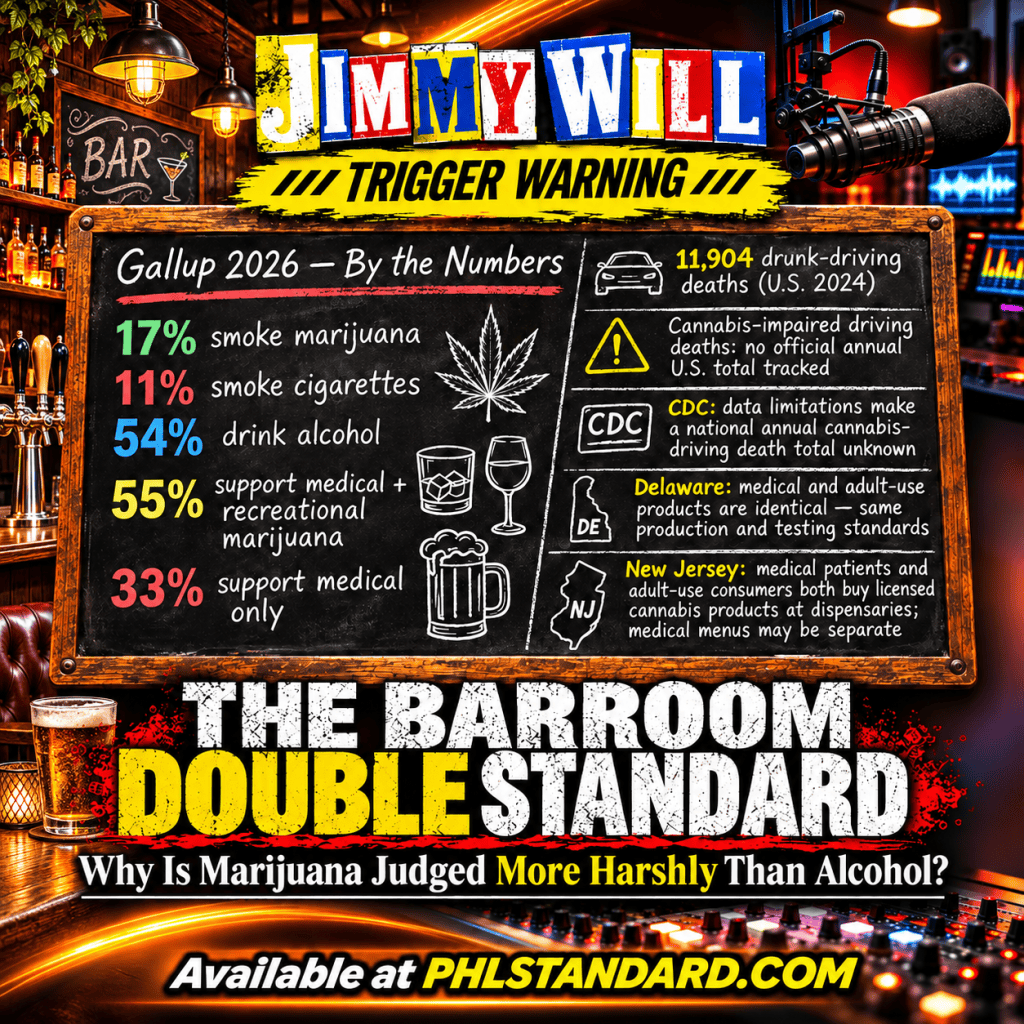
JIMMY WILL | TRIGGER WARNING
Gallup’s 2026 findings reveal that marijuana smoking has overtaken cigarette smoking in America. Yet public attitudes toward cannabis, alcohol, and tobacco expose a deeper contradiction in how Americans judge their legal vices.
I’ve had some of my most interesting debates about marijuana while sitting in bars.
What makes these conversations particularly fascinating is that some of the strongest critics of cannabis are people who are actively consuming alcohol. They will explain how dangerous marijuana is, complain about its smell, and question why anyone would want to use it.
Meanwhile, they’re sitting with a beer, a glass of wine, or a mixed drink in front of them. Sometimes, as the evening progresses, their words begin to slur, and their own intoxication becomes increasingly obvious.
The irony is difficult to ignore.
How does someone who is visibly intoxicated by alcohol conclude that another adult consuming marijuana is engaging in a less acceptable form of recreation?
I am not suggesting that marijuana is harmless or that alcohol should be prohibited. My interest is in understanding why Americans apply such different social standards to substances that people consume for many of the same reasons: relaxation, enjoyment, stress relief, and social interaction.
And new research from Gallup makes that conversation particularly relevant.
Marijuana Has Overtaken Cigarettes, According to Gallup
On August 24, 2026, Gallup published its latest findings on American consumption habits.
The results illustrate just how much the country’s relationship with intoxicating substances has changed.
According to Gallup, 17 percent of American adults report smoking marijuana, 15 percent report consuming marijuana edibles, 11 percent smoke cigarettes, 9 percent vape nicotine, and 54 percent consume alcoholic beverages.
The marijuana smoking figure ties Gallup’s historical high, while cigarette smoking matches its record low.
In 2013, only 7 percent of Americans reported smoking marijuana. By 2026, that percentage had more than doubled.
Cigarette smoking has followed the opposite trajectory. In 1954, approximately 45 percent of American adults smoked cigarettes. Today, that figure stands at just 11 percent.
Alcohol, meanwhile, remains the most widely consumed of these substances, although its popularity has also declined. The 54 percent of Americans who report drinking alcohol represents a record low in Gallup’s historical measurements.
Among Americans who drink, 36 percent identify beer as the alcoholic beverage they drink most often, compared with 32 percent for liquor and 30 percent for wine.
These numbers tell us something important: marijuana is no longer a fringe consumer product. It has become part of mainstream American life.
Yet its cultural acceptance remains complicated.
Americans Know Alcohol Is Harmful, but Continue to Accept It
One of the most revealing aspects of public opinion is how Americans evaluate the potential harm associated with different substances.
In Gallup’s 2024 research, 97 percent of Americans considered cigarettes very or somewhat harmful, compared with 86 percent for alcohol and 66 percent for marijuana.
In other words, Americans were significantly more likely to consider alcohol harmful than marijuana.
Gallup’s 2026 findings also reveal that 51 percent of Americans believe drinking one or two alcoholic beverages per day is bad for their health.
Yet alcohol remains deeply integrated into our social traditions.
We celebrate weddings with champagne. We meet friends for cocktails. We watch sporting events over beer. Restaurants promote wine pairings, and entire entertainment districts revolve around bars and nightlife.
Drinking is not simply tolerated. It is woven into American social culture.
That does not make alcohol inherently worse than marijuana in every circumstance. Both substances carry risks, including impairment and dependence. Alcohol is associated with serious long-term health consequences, while cannabis presents its own risks involving cognition, mental health, dependence, and respiratory exposure when smoked.
But the cultural contrast deserves examination.
Why is alcohol intoxication treated as a familiar part of adult social life, while marijuana intoxication is still viewed by some as evidence of irresponsible behavior?
The difference appears to involve more than scientific assessments of harm. History, familiarity, traditions, and decades of cultural conditioning also help shape public attitudes.
The Medical Marijuana Contradiction
Another interesting debate concerns people who support medical marijuana but oppose recreational marijuana.
According to a January 2026 Pew Research Center survey, 55 percent of Americans support legalizing marijuana for both medical and recreational purposes. Another 33 percent support medical legalization only.
That second group raises an important scientific question.
Do people understand that medical and recreational cannabis can be chemically identical?
The distinction between the two is often not the plant itself but the reason for its use and the regulations governing its sale.
A 2020 peer-reviewed study published in PLOS ONE examined 8,505 cannabis products advertised by 653 dispensaries across nine states.
Researchers found average advertised THC concentrations of 19.2 percent for medical cannabis products and 21.5 percent for recreational products, demonstrating substantial overlap.
Delaware’s Office of the Marijuana Commissioner goes further, explicitly stating that its medical and adult-use marijuana products are identical and subject to the same production and testing standards.
This means someone purchasing cannabis for a medical condition may receive essentially the same product as someone purchasing it for relaxation.
The THC does not become medicinal simply because the consumer possesses a medical marijuana card.
And THC is only part of the scientific discussion.
Cannabis also contains terpenes, naturally occurring compounds that contribute to its aroma and may influence its physiological effects.
Research into terpenes is particularly interesting. A 2024 Johns Hopkins study found that D-limonene, a terpene found in cannabis and other plants, reduced certain anxiety-producing effects of THC in a small clinical experiment.
However, researchers are still investigating how terpenes interact with cannabinoids, and it has not been established that terpenes alone are responsible for cannabis’s medicinal benefits.
The important distinction is that these compounds are not exclusive to products sold under medical marijuana programs.
If someone supports medical cannabis because of its chemical properties but opposes recreational cannabis because they believe the product itself is fundamentally different, that reasoning deserves to be challenged.
Of course, someone can reasonably support medically supervised treatment while opposing unrestricted recreational sales. That is a distinction involving purpose, access, and regulation.
But it is not a distinction necessarily supported by differences in the cannabis being consumed.
The same plant can serve different purposes without becoming a different substance.
The Marijuana Smell Problem Is Real
Of all the complaints I personally hear about marijuana, one stands out more than any other.
The smell.
Interestingly, many of the people who complain about marijuana do not necessarily begin by discussing its health consequences or whether adults should be allowed to use it.
They complain about smelling it in public, in their neighborhoods, or near their homes.
And that concern should not be dismissed.
A 2023 Stockton University poll found that 57 percent of New Jersey adults smelled marijuana in public often or sometimes. Approximately 47 percent said the odor bothered them to some degree, while 52 percent were not bothered.
That is a significant division in public opinion.
But there is a difference between opposing marijuana consumption and opposing unwanted exposure to marijuana smoke.
Someone can support legalization while believing that people should not smoke near building entrances, around children, or in spaces where others cannot easily avoid the odor.
We have already established similar restrictions on cigarette smoking in many public environments.
The same principle can reasonably apply to marijuana.
However, unlike alcohol, marijuana is frequently judged through its most noticeable form of consumption: smoking.
A person can sit in a restaurant drinking wine without the surrounding tables knowing how much alcohol that individual has consumed.
Someone smoking cannabis nearby is much more likely to be noticed.
That visibility influences public opinion.
And the smell argument does not necessarily apply to marijuana edibles, which Gallup reports are consumed by 15 percent of American adults.
If odor is someone’s central objection, then a cannabis edible does not present the same secondhand-smoke problem.
That distinction is important because it separates legitimate concerns about public nuisance from broader objections to cannabis consumption itself.
Back to the Bar: The Question of Hypocrisy
This is where my barroom conversations become particularly interesting.
Imagine someone criticizing marijuana users for becoming intoxicated while that same person is several drinks into an evening.
The individual may be perfectly comfortable with the idea that alcohol helps people relax, socialize, or enjoy themselves.
But when cannabis is discussed, the reasoning changes.
Suddenly, recreational intoxication itself becomes the problem.
That is the double standard I find difficult to reconcile.
If recreational intoxication is considered unacceptable, then the same concern should logically extend to alcohol.
If responsible adults are permitted to consume intoxicating substances recreationally, then the discussion should focus on the actual risks and consequences rather than simply whether one substance is more culturally familiar.
This does not mean every drinker who opposes recreational marijuana is a hypocrite. Some may have legitimate concerns about cannabis dependency, impaired driving, public smoking, or mental health effects.
Those concerns deserve serious consideration.
But someone who condemns marijuana solely because people use it to become intoxicated, while defending alcohol consumption for precisely that purpose, is applying an inconsistent standard.
And the inconsistency becomes particularly noticeable when the person making the argument is visibly impaired by alcohol.
Gallup Reveals a Country Still Deciding What It Thinks About Marijuana
Gallup’s 2026 research found that Americans remain almost evenly divided over marijuana’s effects on most users.
Approximately 47 percent believe marijuana has a positive effect, compared with 46 percent who believe its effects are negative.
Interestingly, marijuana consumption is also more common among adults who drink alcohol.
Gallup found that 21 percent of alcohol drinkers report smoking marijuana, compared with 12 percent of nondrinkers.
This challenges the assumption that marijuana users and alcohol drinkers necessarily belong to opposing social groups.
There is considerable overlap.
Some Americans consume both. Others prefer one over the other. Many consume neither.
That is precisely why discussions about the substances should move beyond stereotypes.
Alcohol drinkers are not inherently irresponsible because they consume alcohol. Marijuana consumers are not inherently irresponsible because they consume cannabis.
The meaningful questions concern how these substances are used, the risks involved, and whether an individual’s behavior harms others.
America’s Legal Vices Need a Consistent Standard
The United States has spent decades changing its approach to cigarette smoking.
The public became increasingly aware of tobacco’s health consequences, smoking restrictions expanded, and cigarette consumption declined dramatically.
Alcohol remains a major part of American culture, even as concern about its health consequences grows.
Marijuana is now following its own path toward mainstream acceptance.
But Americans are still negotiating what that acceptance should look like.
And perhaps that is the real story behind Gallup’s findings.
Marijuana does not need to be declared harmless to justify a reasonable public discussion about its legal use.
Alcohol does not need to be condemned simply because it carries risks.
And people who dislike the smell of cannabis do not need to abandon that legitimate complaint in order to support the rights of responsible adult consumers.
What society should demand is consistency.
If public intoxication is a concern, then impairment deserves attention regardless of the substance.
If secondhand smoke is a concern, then the rules should address unwanted exposure regardless of whether the smoke comes from tobacco or cannabis.
If medical benefits are being discussed, then the science should matter more than the label attached to a dispensary product.
And if recreational relaxation is acceptable for adults drinking beer, wine, or liquor, then the debate over cannabis should explain why the same principle should or should not apply.
The next time I find myself in a bar discussing the dangers of marijuana with someone who is clearly feeling the effects of alcohol, I will return to one simple question:
Are we really judging these substances by their risks, or are we judging them by which forms of intoxication our society has taught us to accept?
Because the difference between a glass of whiskey and a marijuana joint is not simply a question of chemistry.
It is also a question of culture.
And sometimes, the clearest example of that cultural double standard is sitting on the barstool next to you.
Research and Sources
Gallup, U.S. Marijuana Smoking at Record High, Cigarettes at Low, August 24, 2026.
Gallup, Americans’ Drinking Remains at Record Low, August 20, 2026.
Gallup, Americans’ Views of Marijuana Effects Worsen, August 20, 2024.
Pew Research Center, Key Facts About Americans and Marijuana, May 26, 2026.
Stockton University, Poll: 57 Percent of New Jerseyans Smell Marijuana in Public, October 11, 2023.
PLOS ONE, Mapping Cannabis Potency in Medical and Recreational Programs in the United States, 2020.
Johns Hopkins Medicine, Research on D-limonene and THC-induced anxiety, April 2024.
Delaware Office of the Marijuana Commissioner, Medical and adult-use marijuana program information.

