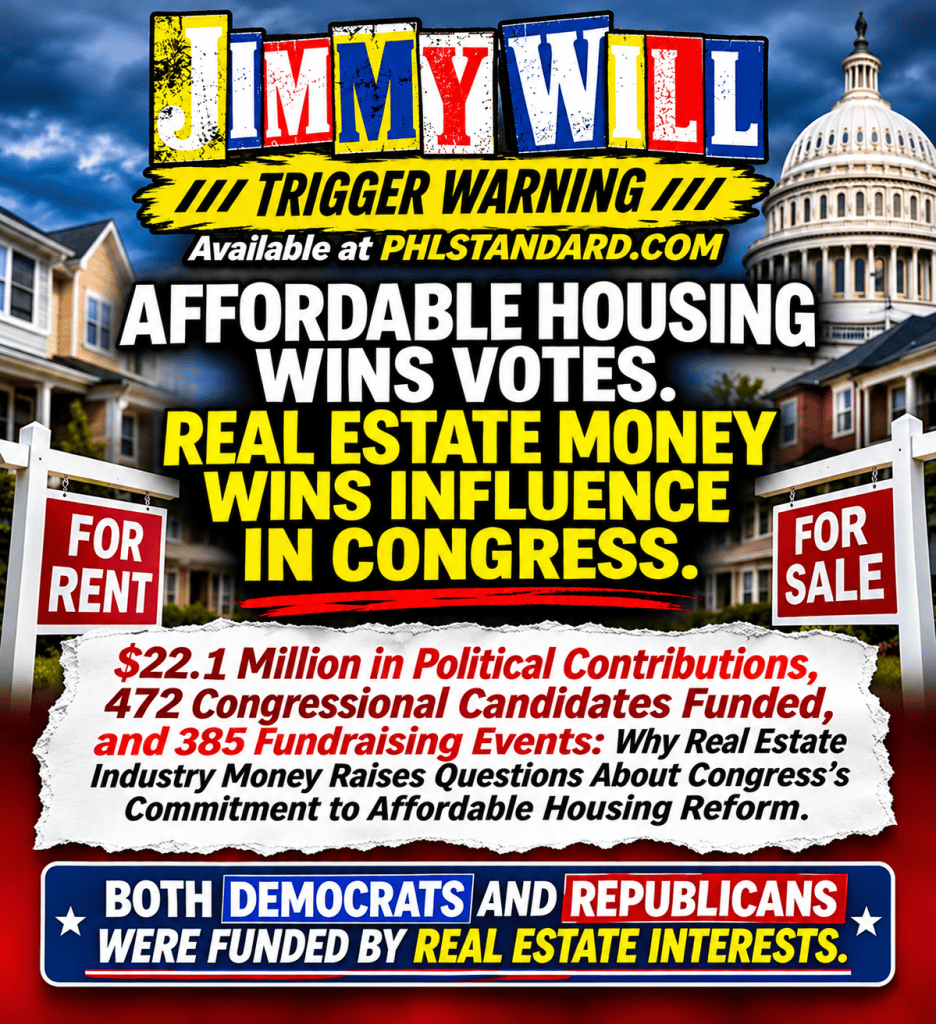
$22.1 Million in Political Contributions, 472 Congressional Candidates Funded, and 385 Fundraising Events. Why Real Estate Industry Money Raises Questions About Congress’s Commitment to Affordable Housing Reform.
By JA Williams Jr.
Jimmy Will Trigger Warning
November 2026
Affordable housing has become one of the most popular political promises in America. Democrats campaign on it. Republicans campaign on it. Congressional candidates tell struggling families they understand the rising cost of rent, the difficulty of purchasing a first home, and the growing reality that working Americans are being priced out of the communities where they live.
But after the elections are over, what happens to those promises?
I understand how campaigns operate, how political relationships are built, and how fundraising influences the legislative environment.
And after examining the real estate industry’s campaign contributions during the 2026 election cycle, I believe the numbers help explain why affordable housing remains such a powerful campaign promise but such a difficult legislative achievement.
FOLLOW THE MONEY
Let’s start with the National Association of Realtors, one of the most politically influential organizations representing real estate interests.
According to Federal Election Commission data compiled through September 30, 2026, the Realtors Political Action Committee contributed $2,166,750 directly to 472 congressional candidates.
Of those recipients, 431 were running for the U.S. House of Representatives and 41 were running for the U.S. Senate.
House candidates received $2,007,500, while Senate candidates received $159,250.
The political distribution was nearly equal. Republican candidates received $1,088,500, while Democratic candidates received $1,025,250. Another $53,000 went to independent candidates or recipients without a reported party affiliation.
That is important because this is not simply a Republican or Democratic issue.
Both parties benefit from real estate political contributions.
But the direct campaign donations represent only one part of the industry’s political involvement.
The National Association of Realtors Congressional Fund reported $22.1 million in contributions to political committees during the 2026 election cycle.
Of that amount, $10.75 million went to the Republican-aligned Senate Leadership Fund, $2.5 million to the Democratic-aligned Senate Majority PAC, $3.5 million to the Republican-aligned Congressional Leadership Fund, and $4.25 million to the Democratic-aligned House Majority PAC.
That represents $13.25 million directed toward major Senate political organizations and $7.75 million toward major House political organizations.
These are contributions to political committees, not direct donations to individual members of Congress, but they demonstrate the financial resources real estate interests can bring to congressional elections.
THE FUNDRAISERS TELL ANOTHER STORY
The National Apartment Association provides another example.
According to its October 2026 political report, its political action committee distributed $2,032,500 to federal candidates and lawmakers during the election cycle.
The association also reported that its staff attended more than 385 fundraising events involving 299 lawmakers and candidates from both political parties.
Think about that.
One organization representing the rental housing industry attended more than 385 political fundraising events during a single congressional election cycle.
Those were events attended by association representatives, not necessarily events the organization hosted.
Nevertheless, they represent opportunities to establish and maintain relationships with the people responsible for writing federal housing policy.
And this is just one organization within a much larger industry that includes real estate brokers, developers, landlords, homebuilders, investment firms, and property management companies.
HOUSING IS A CAMPAIGN ISSUE. REAL ESTATE IS A FINANCIAL INTEREST.
Campaigns need two things: votes and money.
Affordable housing is an issue that attracts voters. It speaks directly to renters, young families, first-time homebuyers, seniors, and working-class Americans struggling to keep up with rising housing expenses.
But the real estate industry provides something equally important to political campaigns: financial support.
That creates a potential conflict between what candidates promise voters and what some of their financial supporters want from government.
I am not suggesting that every real estate company opposes affordable housing. In fact, many developers and homebuilders support policies that would increase housing construction, reduce unnecessary regulations, and expand the housing supply.
Nor am I suggesting that receiving a legal campaign contribution proves a member of Congress has sold a vote.
What I am saying is that political money creates relationships, access, and incentives that voters should not ignore.
Fundraising is not simply about collecting checks. It is also about developing relationships with organizations that have legislative priorities.
Those organizations want their concerns heard when legislation is written, amended, debated, and voted upon.
And that is where I believe meaningful housing reform can become complicated.
WHY I BELIEVE SIGNIFICANT REFORM STALLS
Consider what genuine housing affordability might require.
Congress could consider expanding the supply of affordable homes, reforming housing-related tax incentives, strengthening assistance for first-time buyers, encouraging rental construction, and addressing financial barriers to homeownership.
Some proposals would benefit real estate businesses. Others could challenge the financial interests of certain property owners, investors, or industry organizations.
And Congress does not operate in isolation. State and local zoning laws, construction costs, interest rates, labor availability, and land prices also influence housing affordability.
Still, federal lawmakers control important tax, financing, and housing programs.
My concern is what happens when meaningful reform conflicts with the priorities of politically influential donors.
A campaign contribution does not have to purchase a vote to influence the political process.
Influence can appear in the legislation that receives attention, the amendments that are negotiated, the proposals that never reach the floor, and the compromises that weaken legislation before the public ever sees the final bill.
I believe this is one reason affordable housing can remain a bipartisan campaign promise without producing the scale of reform Americans expect.
That is my interpretation of how political fundraising can affect legislative priorities. The contribution figures alone do not establish that any particular housing bill was blocked because of donations.
But they raise questions worth investigating.
MORE GRANTS, MORE BUILDINGS, BUT IS HOUSING ACTUALLY AFFORDABLE?
Let me be clear about what I expect will happen.
There will be more government grants announced. More housing programs will receive funding. More attractive affordable housing developments will be constructed, complete with ribbon-cutting ceremonies, elected officials, and press releases celebrating another investment in our communities.
And some families will genuinely benefit from those developments.
But will these projects solve the larger affordability problem that brought voters to the polls in the first place?
In my opinion, no.
A few hundred new affordable units in a community where thousands of families are struggling with housing costs may represent progress, but it does not necessarily represent a solution.
A new apartment building with income-restricted units does little for the working family that earns too much to qualify for assistance but not enough to afford market-rate housing.
A first-time homebuyer grant may help someone with a down payment, but it does not automatically address high home prices, mortgage interest rates, property taxes, or the limited supply of reasonably priced homes.
And a government-funded development can create new housing opportunities without significantly reducing rents throughout the surrounding market.
That is the distinction I believe politicians often avoid.
Building affordable housing units is not the same thing as making housing affordable for the American people.
One produces projects that politicians can point to. The other requires broader changes in housing costs, supply, financing, and household purchasing power.
I expect Congress will continue funding programs, announcing grants, and celebrating individual developments. Those initiatives can have real value, but I remain skeptical that they will produce the widespread affordability voters were promised.
The question should not simply be how much money Congress spent or how many developments were completed.
The question should be whether ordinary Americans can afford to rent or purchase a home without being financially overwhelmed.
If the answer remains no, then the underlying problem has not been solved.
DEMOCRATS AND REPUBLICANS HAVE THE SAME PROBLEM
One of the biggest mistakes Americans make is believing that replacing one political party with the other automatically changes the financial interests surrounding Congress.
Look at the contribution figures.
The Realtors PAC distributed money to both Democrats and Republicans in nearly equal amounts.
Meanwhile, the NAR Congressional Fund directed millions toward major political organizations associated with both parties, although Republican-aligned organizations received more in this particular cycle.
The real estate industry does not have to depend exclusively on one party to maintain political relationships.
It can establish relationships across the aisle.
Meanwhile, voters are encouraged to believe that electing a different party will finally solve the housing crisis.
I believe this is one of the fundamental contradictions of our political system.
The campaign messages change. The candidates change. Congressional majorities change.
But many of the financial interests seeking influence in Washington remain involved regardless of which party controls Congress.
THE QUESTION AMERICANS SHOULD BE ASKING
When a congressional candidate promises affordable housing, voters should ask more than whether that candidate supports the idea.
They should ask who is financing the campaign.
They should examine which real estate organizations contribute to the candidate, what housing legislation those organizations support or oppose, and how the candidate votes when those interests conflict with proposals to reduce housing costs.
Campaign finance disclosures make those questions possible.
I believe the public deserves a more serious discussion about the relationship between campaign financing and housing policy.
Not every donation represents improper influence. Not every housing proposal opposed by the industry is necessarily good legislation. And not every affordable housing failure originates in Congress.
But when organizations representing real estate interests distribute millions of dollars across both political parties and participate in hundreds of congressional fundraising events, it is reasonable to question how those relationships affect legislative priorities.
MY CONCLUSION: THE VOTES COME FROM THE PEOPLE. THE MONEY COMES FROM THE INDUSTRY.
This is why I remain skeptical that Congress will deliver significant affordable housing reform simply because politicians continue promising it during election season.
Affordable housing attracts voters because millions of Americans need relief.
Real estate interests contribute campaign money because federal policy affects their businesses, investments, and financial interests.
Both groups have legitimate reasons to participate in the political process. But they do not have equal financial resources.
And when the interests of voters and politically connected donors conflict, I believe the influence of campaign financing can become a major obstacle to substantial reform.
That is not a conclusion that every member of Congress is corrupt. It is my assessment of the incentives built into the political system.
Americans should demand evidence of legislative progress rather than accepting another campaign promise.
Sure, there will be more grants. There will be more attractive affordable housing developments. There will be more politicians standing in front of new buildings taking credit for addressing the housing crisis.
But will the average working American find it substantially easier to afford a home?
That is the measure that matters to me.
Because affordable housing may help politicians win elections, but the political financing surrounding housing policy deserves just as much attention as the promises made to voters.
And until Americans begin following the campaign money as closely as they follow campaign promises, I believe affordable housing will continue to be a winning political message without delivering the meaningful reform voters expect.
SOURCES AND DATA
Federal Election Commission, National Association of Realtors Political Action Committee, 2025 to 2026 election cycle.
MyRepTracker, Realtors PAC candidate contribution analysis, filings through September 30, 2026.
Federal Election Commission, National Association of Realtors Congressional Fund, 2026 financial disclosures.
National Apartment Association, NAAPAC Insider, October 29, 2026.
National Apartment Association, Political Affairs Update, November 10, 2026.
Editor’s Note: Financial figures reflect the cited reporting periods and are not final industry-wide totals. Candidate recipient counts include candidates who did not win election. The article’s conclusions about the relationship between campaign contributions and housing reform are the author’s political opinions, not findings of a demonstrated causal relationship.

