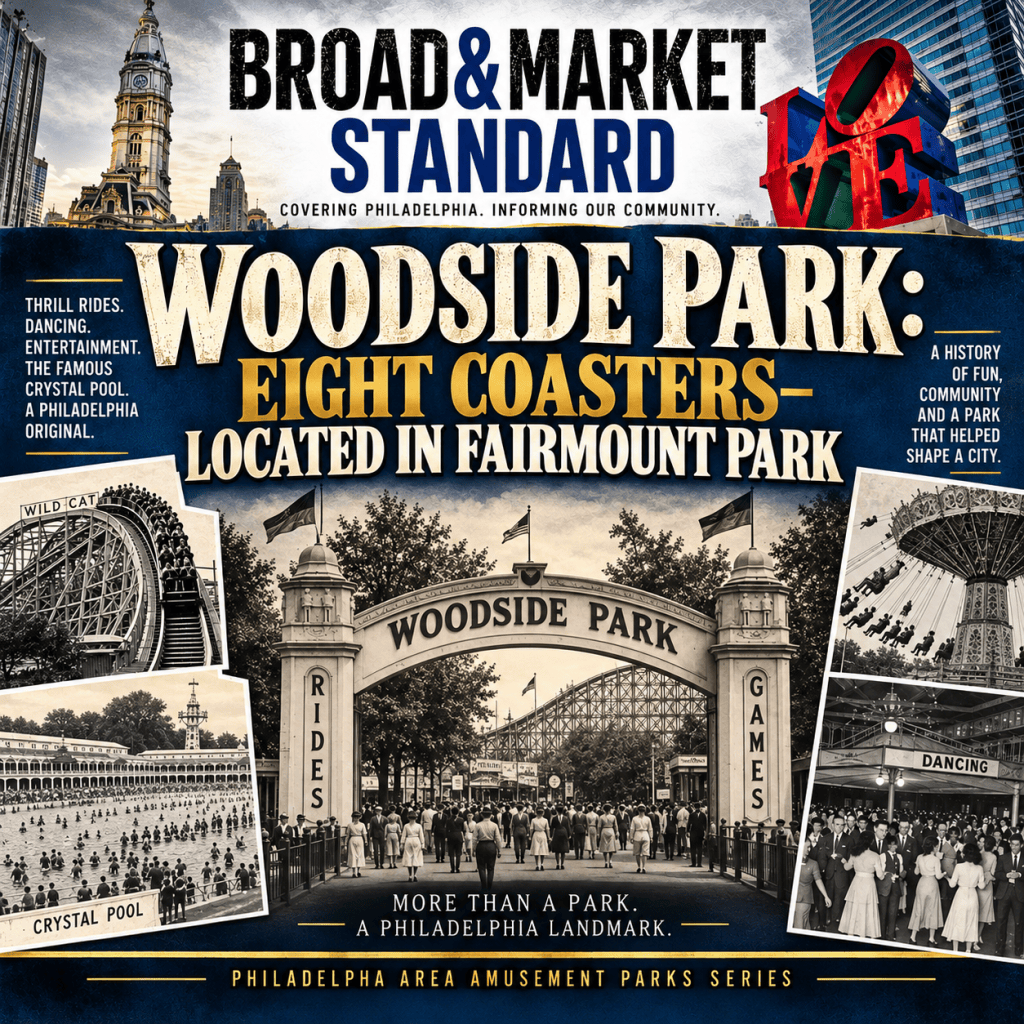
Woodside Park may be one of the most fascinating—and important—forgotten amusement parks in Philadelphia history.
Opened in 1897, Woodside Park stood near Ford and Monument Roads alongside West Fairmount Park. For generations of Philadelphians, it offered something that today seems almost impossible to imagine: a major amusement park filled with roller coasters, rides, entertainment and swimming located right inside Philadelphia.
Transportation helped make Woodside possible. The Fairmount Park Transportation Company brought visitors to the area by trolley, making the park accessible to thousands of residents looking for an escape from the streets and neighborhoods of the growing industrial city.
And Woodside was no small amusement park.
Modern roller-coaster records document eight roller coasters operating at Woodside during its history: Wild Cat, Tornado, Hummer, Storm, Velvet Coaster, Thompson’s Scenic Railway, Thompson’s Thriller and Baby Wild Cat.
Eight roller coasters at one Philadelphia amusement park.
Imagine leaving your Philadelphia neighborhood, taking a trolley toward Fairmount Park and arriving at a destination where wooden roller coasters towered above the landscape.
Woodside offered much more than thrill rides. Visitors could find dancing, entertainment, children’s attractions and other recreational activities. One of the park’s most impressive facilities was the enormous Crystal Pool, which opened in 1926 and could accommodate thousands of swimmers.
But the story of Crystal Pool also reveals a much more complicated part of Woodside’s history.
Black Philadelphians could enjoy Woodside’s amusement rides, but they did not receive equal access to everything the park offered.
Crystal Pool operated under a supposed membership system that effectively excluded African Americans. Black customers attempting to obtain memberships could be told that the facility was full while white customers continued to receive admission.
Black Philadelphians challenged those discriminatory practices.
Educators, activists and community members organized against the policies. In 1945, Philadelphia educator and activist Arthur Huff Fauset participated in an organized effort challenging discrimination at Crystal Pool. Woodside’s Roller-Drome also became the subject of protests over discriminatory practices.
The fight ultimately produced an important change.
In 1952, Philadelphia’s Department of Recreation took over operation of Crystal Pool and integrated the facility after the private operator resisted admitting African Americans.
That history makes Woodside significant for reasons extending far beyond roller coasters and amusement rides.
The park represents two parts of Philadelphia’s past existing in the same place: the city’s ability to create enormous recreational attractions for its residents and the struggle of Black Philadelphians to receive equal access to those attractions.
Woodside Park closed following the 1955 season, ending nearly six decades of amusement history.
Yet an extraordinary piece of Woodside survives.
The park’s historic Dentzel Carousel was preserved and today operates at Philadelphia’s Please Touch Museum, allowing new generations of children and families to experience a physical connection to the old amusement park.
Woodside Park is difficult to picture in modern Philadelphia. An amusement park with eight roller coasters, a massive swimming pool, dancing and entertainment once stood alongside Fairmount Park.
But it existed.
And its story deserves to remain part of Philadelphia history.
Woodside wasn’t simply an amusement park.
It was a place where Philadelphians came to ride, swim, dance and escape everyday life—and where another battle over equality in Philadelphia was fought.
Philadelphia Area Amusement Parks Series
Broad & Market Standard

