By JA Williams Jr
Philadelphia legislator’s bill would impose $5,000 fines and permanently revoke licenses from repeat offenders
State Rep. Amen Brown has moved one of his youth-protection initiatives a significant step closer to becoming Pennsylvania law.
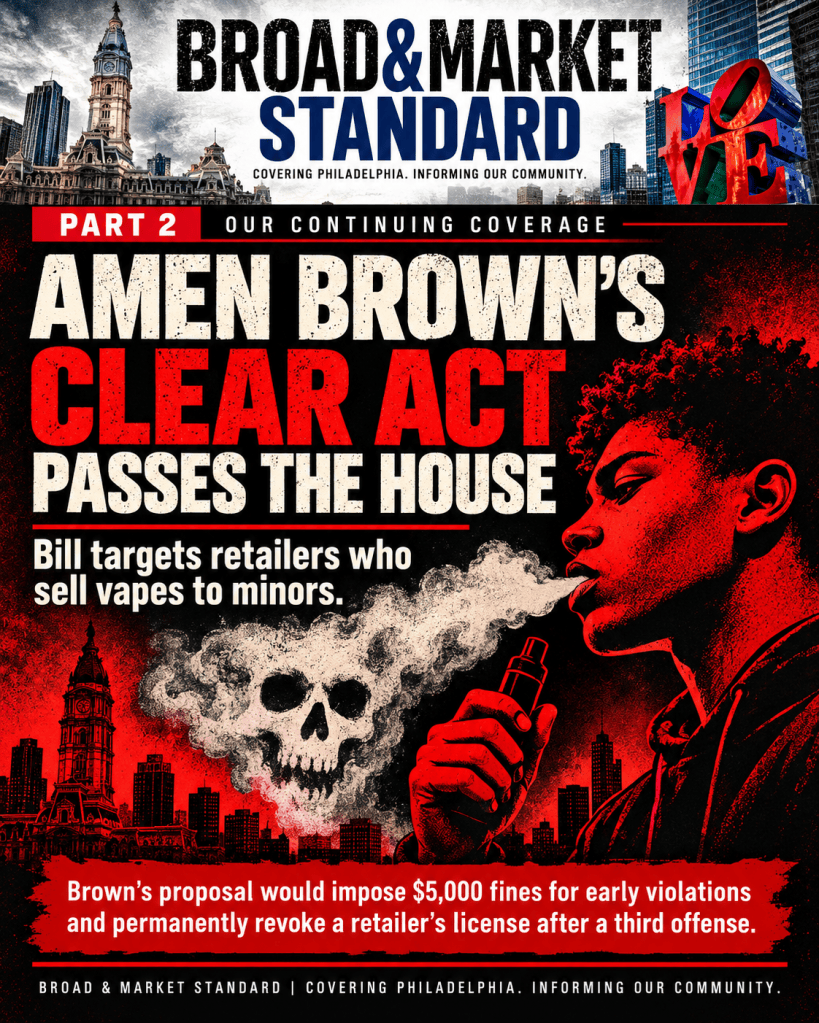
On Monday, Oct. 5, the Pennsylvania House voted 202-0 to approve House Bill 1434, legislation sponsored by Brown that would dramatically increase penalties on retailers caught illegally selling electronic cigarettes and other electronic nicotine delivery systems to minors. Brown, a Philadelphia Democrat representing the 10th Legislative District, introduced the legislation in May 2025.
Brown has dubbed the legislation the CLEAR Act, framing the measure not simply as an anti-vaping proposal but as an effort to hold businesses accountable when they provide addictive nicotine products to young people.
“Vaping has become a silent epidemic in our schools and neighborhoods,” Brown said following the House vote. “This is not just a public health issue — it’s a community safety issue. If you’re out here profiting off the addiction of our youth, you should not be in business — period.”
What Brown’s bill would actually change
Pennsylvania already prohibits retailers from selling tobacco and nicotine products to people classified as minors under state law, generally those under 21. The significance of Brown’s legislation is in the consequences imposed on retailers who violate that law.
Under current Pennsylvania law, retailer fines begin at between $100 and $500 for a first violation, rise to between $500 and $1,000 for a second offense, and reach between $1,000 and $3,000 for a third offense. A fourth or subsequent offense can bring a fine between $3,000 and $5,000. Current law also allows a retailer’s cigarette license to be suspended for up to 30 days after a third conviction within 24 months and revoked for up to 60 days following a fourth conviction.
Brown’s HB 1434 establishes a substantially tougher structure specifically for retailers illegally selling electronic nicotine delivery systems.
A retailer convicted of a first or second offense would receive a $5,000 fine. On the third offense, the retailer would receive another $5,000 fine and face permanent revocation of its tobacco products tax license. If enacted, the law would take effect 60 days later.
That distinction is important. Brown’s proposal is not a statewide ban on flavored vaping products. Instead, it targets the point of sale by increasing the cost of illegally selling those products to young customers.
Pennsylvania numbers help explain Brown’s push
The issue is particularly relevant in Pennsylvania.
The Pennsylvania Department of Health’s most recent high-school tobacco fact sheet uses 2023 Youth Risk Behavior Survey data and reports that 16% of Pennsylvania high school students currently used electronic vapor products. About one-third — 33.7% — reported having tried vaping at some point.
Perhaps more directly connected to Brown’s legislation, the state reported that 14.6% of Pennsylvania high school students said they purchased electronic vapor products themselves at retail outlets.
Those numbers give Brown’s proposal a different focus than programs aimed exclusively at educating young people about vaping. HB 1434 puts a portion of the responsibility on the businesses making the transactions.
Brown made that enforcement philosophy clear when he first circulated the proposal to fellow lawmakers in May 2025. He argued that Pennsylvania’s existing penalty structure was not strong enough to deter retailers from selling vaping products to minors and proposed making repeat violations capable of putting a retailer out of the tobacco business permanently.
Youth vaping has declined nationally — but remains substantial
National numbers provide some additional context.
The CDC reported that youth e-cigarette use declined between 2023 and 2024. Still, approximately 1.63 million middle and high school students reported current e-cigarette use in 2024. That included approximately 1.21 million high school students, or 7.8% of high school students surveyed. E-cigarettes remained the most commonly used tobacco product among American youth.
Flavors remain a major part of youth vaping.
Among students who currently used e-cigarettes in the 2024 national survey, 87.6% reported using flavored products. Fruit flavors were reported by 62.8% of current users, candy, dessert or other sweet flavors by 33.3%, and mint by 25.1%.
Those numbers add context to Brown’s repeated focus on candy- and fruit-flavored products when discussing the legislation.
“Communities across Pennsylvania are watching our kids get hooked on high-nicotine products disguised in candy flavors,” Brown said. “Enough is enough. It’s time to clear the air.”
Brown built bipartisan support
Another significant part of the legislation’s path is the level of support Brown assembled.
HB 1434 was introduced on May 8, 2025. The House Judiciary Committee approved the measure in June 2026, with the committee vote also unanimous at 26-0. After amendments and additional consideration in September, the full House gave Brown’s bill final passage on Oct. 5 by 202-0. The bill has Democratic and Republican co-sponsors.
For Brown, who has represented Philadelphia in the state House since 2021 and has represented the 10th District since 2023, the legislation represents a concrete attempt to address a neighborhood problem through retailer enforcement rather than placing the burden entirely on young people, parents and schools.
The approach can be summarized simply: selling vaping products to minors is already illegal in Pennsylvania; Brown wants the financial and licensing consequences to become severe enough that retailers have considerably more to lose by ignoring the law.
The House has now unanimously endorsed that approach.
HB 1434 next moves toward consideration in the Pennsylvania Senate. As of Oct. 6, the General Assembly’s official bill history lists the Oct. 5 House passage as its latest recorded legislative action.
Whether the Senate ultimately advances the measure remains to be determined. But Brown has succeeded in moving a bill he introduced more than a year ago through the Pennsylvania House without a single dissenting vote — putting his proposal to increase accountability for retailers selling vapes to young people squarely before the other chamber.One editorial point worth keeping: I deliberately made clear that Brown’s bill is not a flavor ban. It is an enforcement bill aimed at retailers selling electronic nicotine products to minors, which makes the story more precise and defensible.

