By Staff
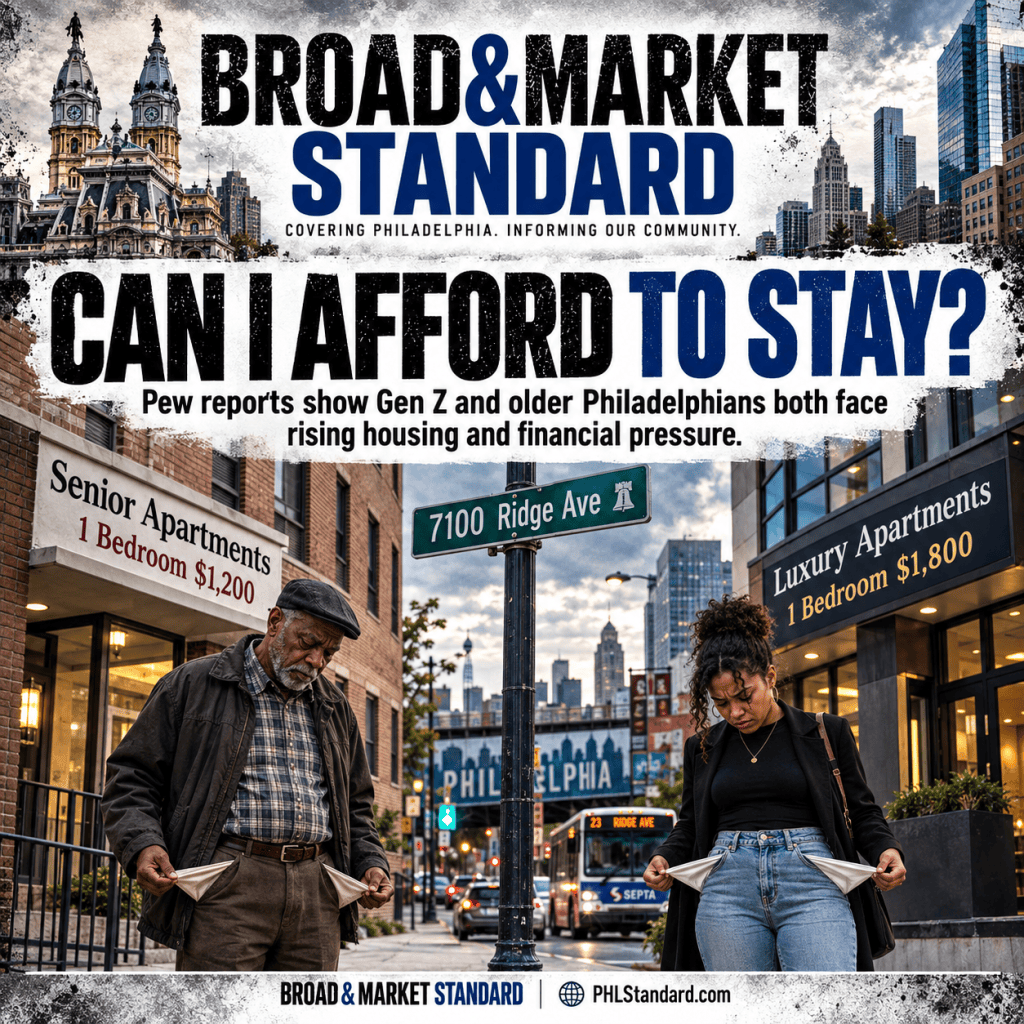
Two recent Pew studies reveal a common concern across generations: Philadelphians want to remain connected to the city, but jobs, wages, housing costs and financial insecurity are making that increasingly difficult.
Philadelphia has long benefited from something many cities struggle to create: people actually want to live here.
Young adults are drawn to the city’s neighborhoods, universities, culture, restaurants, transit and relative affordability compared with places such as New York and Washington.
Older residents often want to remain in the neighborhoods where they have spent decades building families, friendships and community ties.
But two recent reports from The Pew Charitable Trusts raise an important question for Philadelphia:
Can people afford to stay here through every stage of life?
Pew separately examined two very different groups: young adults ages 18 to 29 and residents age 65 and older. The studies were based on focus groups rather than representative polling, so they are best understood as detailed accounts of residents’ experiences rather than measurements of how every Philadelphian feels.
Still, when the findings are placed side by side, the similarities are hard to ignore.
Young Philadelphians worry about earning enough and finding careers that allow them to establish themselves in the city.
Older Philadelphians worry about whether housing costs, fixed incomes and access to services will allow them to remain here.
Gen Z Likes Philadelphia, But Wants More Opportunity
Pew’s report, “Gen Z Likes Philadelphia but Feels Frustrated by Low Pay, Limited Jobs,” examined the experiences of Philadelphia residents ages 18 to 29.
The young adults Pew spoke with generally had positive feelings about Philadelphia.
Family, friends, affordability and city life were among the reasons many wanted to remain.
The problem was not necessarily Philadelphia itself.
The problem was opportunity.
Participants consistently described a good job as one that provides competitive wages, health benefits, work-life balance, opportunities to develop skills and a clear path toward advancement.
Philadelphia has obvious strengths in health care and education. Those sectors employ a significant share of the city’s younger workers.
But participants pursuing careers in areas such as technology, finance and the arts sometimes described Philadelphia’s employment market as more limited.
Pay was another major concern.
Pew found that median earnings for younger Philadelphia workers were below those of comparable young workers in several other major East Coast cities, including Boston, Washington, New York and Baltimore.
Philadelphia may be less expensive than some of those cities, but lower wages can still create a problem when rent, transportation, food and other everyday expenses continue increasing.
That creates a larger challenge.
Philadelphia has traditionally done a reasonably good job attracting young adults.
The harder part may be keeping them as they move into their 30s, advance professionally, purchase homes and begin families.
At that point, the question changes from:
“Do I like Philadelphia?”
to:
“Does staying in Philadelphia still make financial sense?”
Seniors Are Asking a Similar Question
At the other end of adulthood, Pew found many older Philadelphians wrestling with their own version of that same question.
Its report, “Older Philadelphians Share Concerns Over Finances, Access to Housing and Services,” examined residents age 65 and older.
Philadelphia’s senior population increased approximately 24% between 2014 and 2024 and now represents roughly 15% of the city’s population.
That is a significant demographic shift.
The Northwest Philadelphia connection is particularly important.
Nine of the 26 participants in Pew’s focus groups came from Northwest Philadelphia and Mt. Airy.
That makes the findings especially relevant to neighborhoods where longtime homeowners, renters and retirees are increasingly confronting the economics of aging in place.
Many older residents said they valued Philadelphia’s health-care institutions, public transportation and neighborhood connections.
But financial security was a recurring concern.
Some homeowners may have paid off their mortgages, yet still face rising property taxes, insurance, utilities, maintenance and condominium fees.
Renters face an even more uncertain situation.
A senior living on a fixed income may be able to manage a $900 rent payment today but struggle if that rent becomes $1,100 or $1,200.
For someone whose income is primarily Social Security, a rent increase is not simply an inconvenience.
It can fundamentally change whether remaining in the neighborhood is possible.
Pew also found that some older residents fall into a difficult middle ground.
They may earn too much to qualify for certain assistance programs while still not earning enough to comfortably absorb increasing housing, transportation and health-care costs.
That creates the same underlying question facing younger residents:
Can I afford to stay?
Housing Connects Both Generations
Housing may be where the experiences of Gen Z and seniors overlap most clearly.
A younger worker could earn enough to rent an apartment but not enough to save for a down payment.
A senior citizen may own a house but struggle with repairs, taxes and utilities.
A young renter may look at a one-bedroom apartment advertised for $1,800 and wonder how much income remains after rent.
An older resident may look at a senior apartment advertised for $1,200 and ask whether that is really affordable on a fixed retirement income.
The apartments are different.
The stages of life are different.
The financial pressure is remarkably similar.
Housing affordability is therefore not merely a poverty issue.
It increasingly affects young professionals, working families, retirees and longtime homeowners.
Transportation Matters Too
Transportation was another common concern, although each generation experiences it differently.
Young workers often rely heavily on SEPTA, walking and biking.
For them, unreliable transit or a long commute can limit which jobs are realistically available.
A job paying slightly more money may not be more attractive if reaching it requires two buses, a train and nearly two hours of commuting every day.
Older residents often value Philadelphia’s transit system because it allows them to maintain independence without driving.
Senior fares and access to buses and regional rail can help residents reach doctors, grocery stores, family members and community activities.
But accessibility and safety become increasingly important as people age.
A city that wants residents to remain throughout their lives must therefore think about transportation as an economic issue as much as an infrastructure issue.
Philadelphia’s Bigger Challenge
Philadelphia may not have a problem convincing people that the city is worth living in.
Pew’s research suggests that many residents already believe that.
The challenge is whether Philadelphia can provide the economic conditions necessary for them to remain.
For a 25-year-old, that may mean finding a job that pays enough to rent comfortably, save money and eventually purchase a home.
For a 45-year-old, it may mean raising a family without feeling compelled to leave the city for housing, schools or employment.
For a 75-year-old, it may mean remaining in a familiar neighborhood without being overwhelmed by housing costs, taxes and other expenses.
These are often discussed as separate policy problems.
Youth employment.
Housing affordability.
Senior services.
Transportation.
Taxes.
But perhaps they are all pieces of the same larger issue.
Philadelphia must become a city where residents can not only arrive and survive, but also build, grow and remain.
Because the most important question may no longer be whether people want to live in Philadelphia.
It may be much simpler:
Can I afford to stay?

