BOARDWALK STANDARD | ATLANTIC CITY NEWS
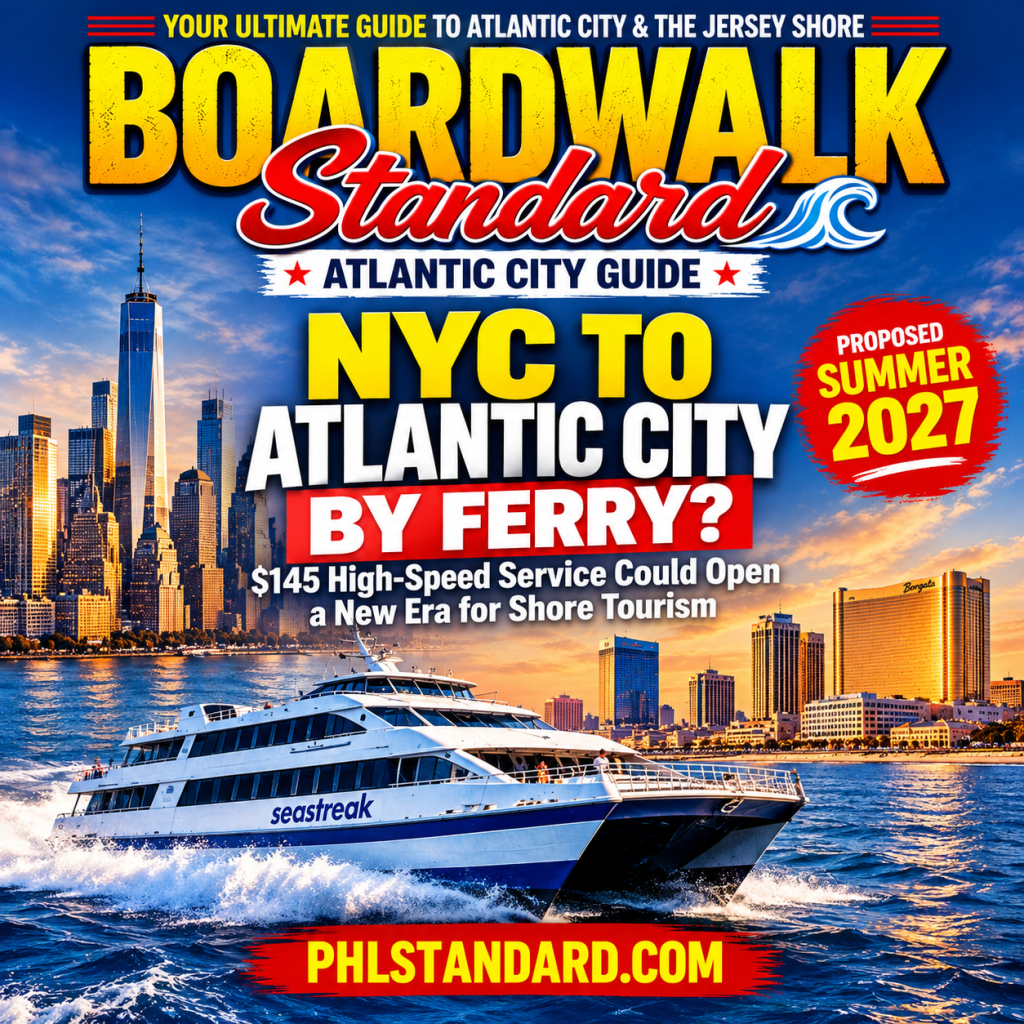
### NYC to Atlantic City by Ferry? $145 High-Speed Service Could Open a New Era for Shore Tourism
Proposed 2027 service could connect Manhattan to Atlantic City’s Marina District as the resort attracts casino investment, residential interest and millions of annual visitors.
By Boardwalk Standard | October 11, 2026
ATLANTIC CITY, NJ — A trip from New York City to Atlantic City could soon involve ocean views instead of highway traffic.
A proposed high-speed passenger ferry connecting Manhattan with Atlantic City is being explored for summer 2027, potentially creating a new transportation link between the nation’s largest metropolitan area and one of the East Coast’s most established seaside resorts.
According to reporting published October 11 by The Philadelphia Inquirer, the proposed service would take approximately two and a half hours, cost an estimated $145 round trip and bring passengers to the Frank S. Farley State Marina near Golden Nugget.
Ferry operator Seastreak has expressed interest in the route, which is also being promoted by developers associated with the proposed $4 billion redevelopment of Atlantic City’s former Bader Field airport.
Seastreak owner James Barker indicated that the company is evaluating the service, including vessel availability and potential passenger demand. Two of the company’s high-speed vessels, the Courageous and Commodore, have been discussed as possible options, each capable of accommodating approximately 600 passengers.
However, the service remains in the feasibility stage. No operating schedule, ticket sales or confirmed launch date have been announced.
The proposed Memorial Day weekend 2027 opening remains a target rather than a commitment.
Atlantic City’s Tourism Economy Remains Substantial
Atlantic City’s existing tourism industry provides a potential customer base for the proposed service.
According to Stockton University’s Lloyd D. Levenson Institute of Gaming, Hospitality and Tourism, Atlantic City attracted an estimated 17.6 million visitors in 2025, a 2.6% decrease from the previous year.
Although visitation declined slightly, the figures demonstrate the continued scale of the resort’s tourism economy.
The city’s meetings and convention business also remains an important economic driver.
Visit Atlantic City reported that 205 meetings, conventions and trade shows generated approximately $362.3 million in economic impact during 2025. Those events attracted 533,242 attendees and produced 328,067 hotel room nights.
The proposed ferry could provide another transportation option for this established visitor market, particularly for New York travelers who prefer not to drive.
New Jersey Tourism Spending Reaches $51.9 Billion
The ferry proposal comes as New Jersey’s statewide tourism economy continues to expand.
According to the New Jersey Division of Travel & Tourism, the state welcomed approximately 124.2 million visitors in 2025, compared with 123.7 million in 2024.
Visitor spending reached $51.9 billion, an increase of 2.7% over the previous year.
Food and beverage spending increased 4.7%, lodging spending rose 4.1%, and recreation spending grew 2.3%.
Those industries are central to Atlantic City’s economy, where casinos, hotels, restaurants, beaches, concerts and entertainment venues compete for visitors throughout the year.
While statewide spending increased, Atlantic City’s estimated visitor count declined slightly. The figures therefore suggest a substantial regional tourism market rather than uninterrupted growth in the resort itself.
New York Has Long Been an Important Atlantic City Market
The potential connection between New York and Atlantic City is not new.
A New Jersey government-hosted tourism analysis citing a 1993 Atlantic City visitor study reported that New York City accounted for approximately 48% of day visitors and 34% of overnight visitors in the study’s city-of-origin figures.
Although those estimates are more than three decades old and do not represent current travel patterns, they demonstrate the longstanding relationship between the two markets.
More recently, Visit Atlantic City has identified New York City as a priority advertising market alongside Philadelphia, Washington and Boston.
The organization has also commissioned visitor-profile research to better understand where travelers originate and what motivates them to visit Atlantic City.
Current year-over-year figures specifically measuring New York City visitors to Atlantic City have not been established in the available reporting. Consequently, the historical data does not prove that NYC-to-Atlantic City travel is increasing today.
Nevertheless, the longstanding relationship provides a potential foundation for the proposed ferry service.
Atlantic City’s Housing Market Draws New York Interest
Residential real estate activity offers another indication of interest in Atlantic City beyond the immediate South Jersey market.
According to Redfin, Atlantic City’s median home sale price reached approximately $235,000 during the three months ending August 2026, an increase of 23.7% compared with the same period a year earlier.
The company reported 105 home sales in August 2026, compared with 97 during the previous August, with properties spending an average of 106 days on the market.
Other housing indicators show more moderate appreciation. Zillow’s typical home value index increased approximately 1.9% annually through July 2026, illustrating how different measures can produce different assessments of the market.
Redfin’s homebuyer migration analysis also identified the New York metropolitan area as the leading outside source of online home-search interest in the Atlantic City market during April through June 2026.
The analysis estimated 3,108 net inbound home-search users from the New York metropolitan area. Those figures measure modeled online interest rather than completed purchases or confirmed relocations.
Still, the data suggests Atlantic City is attracting attention from prospective buyers outside the region.
For seasonal residents, second-home owners and prospective investors maintaining connections to New York, a direct ferry could become an additional transportation amenity.
Its usefulness would depend on operating frequency, ticket prices and reliability.
Casinos Invest More Than $1.2 Billion
Atlantic City’s casino industry continues to invest in property improvements and entertainment facilities.
According to a 2026 report from the Casino Association of New Jersey and Stockton University, casino operators invested more than $1.2 billion in capital improvements between 2021 and 2025, including approximately $195.6 million during 2025.
The industry also purchased approximately $634 million in goods and services from New Jersey vendors during 2025, including $373.9 million in Atlantic County.
Approximately 22,500 New Jersey residents were employed in the casino industry, including roughly 4,600 Atlantic City residents.
These investments demonstrate the industry’s continued economic importance and could create opportunities for transportation partnerships.
Hotels and casinos might eventually offer ferry packages combining transportation, accommodations, dining and entertainment.
The proposed marina arrival point would place passengers near Golden Nugget, Borgata and Harrah’s Resort, potentially creating additional business for Atlantic City’s Marina District.
However, convenient connections to the Boardwalk and other neighborhoods would be important if the economic benefits were to extend throughout the city.
Bader Field’s $4 Billion Redevelopment Vision
The ferry proposal is also connected to plans for the former Bader Field municipal airport.
Deem Enterprises has proposed transforming the site into the Intercoastal Motorcar & Yacht Club, a development estimated at $4 billion.
Plans include approximately 1,237 residences, luxury waterfront condominiums, townhouses, commercial amenities, recreational facilities, public pathways and a private driving circuit.
According to The Philadelphia Inquirer, the proposed agreement includes a $100 million property purchase and a $15 million contribution toward a community center.
Developer Tommy Carr has promoted improved transportation connections as part of Atlantic City’s broader redevelopment vision.
However, the Bader Field project continues to face regulatory requirements, including environmental approvals. Its construction and completion are not guaranteed.
The proposed ferry and redevelopment project remain separate undertakings, and neither guarantees the completion of the other.
What Could the Ferry Mean for Atlantic City’s Economy?
A successful ferry connection could generate economic opportunities beyond casino gaming.
Hotels could introduce weekend packages combining ferry transportation and accommodations. Restaurants could coordinate dining promotions around ferry arrival times, while entertainment venues could market concerts, festivals and special events to New York visitors.
Local transportation companies could also benefit from passengers arriving without personal vehicles.
To illustrate the potential spending involved, consider a hypothetical seasonal operation bringing 300 arriving passengers to Atlantic City on each of 30 operating days.
That would represent 9,000 passenger arrivals.
If each passenger spent an additional $150 locally, the resulting gross visitor spending would total approximately $1.35 million.
That example is illustrative rather than a ridership forecast or formal economic-impact estimate. It assumes the spending is genuinely additional, rather than spending by travelers who would have visited Atlantic City using another transportation method.
A complete economic analysis would need to account for new visitor demand, average spending, operating costs, employment and the share of tourism revenue retained locally.
The Challenge: Can a $145 Ferry Attract Enough Passengers?
Despite the potential economic advantages, several questions remain.
At an estimated $145 round trip, the proposed ferry would compete as a premium travel experience rather than a low-cost transportation alternative.
Existing buses and automobiles already connect New York and Atlantic City, and a two-and-a-half-hour ferry journey would not necessarily be faster than every ground transportation option.
The ferry’s potential advantage would likely involve convenience, the onboard experience and the ability to travel without a car.
Weather conditions, seasonal demand, fuel expenses, terminal arrangements and vessel availability would also influence operating costs.
Seastreak already operates high-speed passenger ferries between New York and New Jersey, along with seasonal routes serving destinations including Martha’s Vineyard and Nantucket.
That experience provides an existing operational model, but Atlantic City would still need to demonstrate sufficient demand to support its own route.
A New Transportation Opportunity for Atlantic City
Atlantic City’s tourism industry already attracts millions of visitors annually, while its casinos continue to invest in property improvements and its residential market draws interest from outside South Jersey.
New York has historically been an important visitor market, and the proposed ferry would provide another way to connect the two destinations.
Whether the service becomes reality will depend on passenger demand, operating economics and Seastreak’s ability to dedicate vessels to the route.
For now, the proposed Memorial Day weekend 2027 launch remains tentative.
But the larger economic opportunity is clear: a direct passenger ferry could introduce another way for New York visitors to reach Atlantic City’s hotels, restaurants, entertainment venues and waterfront attractions.
A high-speed ferry would not create Atlantic City’s tourism economy. That economy already exists. The question is whether a direct connection to Manhattan could bring additional visitors, spending and investment to the resort.
For Atlantic City, the answer could help determine whether the proposed ferry becomes a lasting transportation option or remains an ambitious waterfront concept.
Sources: The Philadelphia Inquirer (October 11, 2026); Stockton University Lloyd D. Levenson Institute of Gaming, Hospitality and Tourism; Visit Atlantic City; New Jersey Division of Travel & Tourism; Casino Association of New Jersey; Redfin; Zillow; and New Jersey government-hosted historical tourism research. Ferry details remain proposed, and the economic figures are attributed to their respective reporting sources.
BOARDWALK STANDARD | PHLStandard.com

